AI comes to the UN Security Council: what tech leaders and African states said
An unprecedented Security Council debate with the heads of OpenAI, Anthropic and Hugging Face, a call from Macron and the pope for international oversight, and a message from Paul Biya on sharing the benefits: UN week put AI governance front and centre.
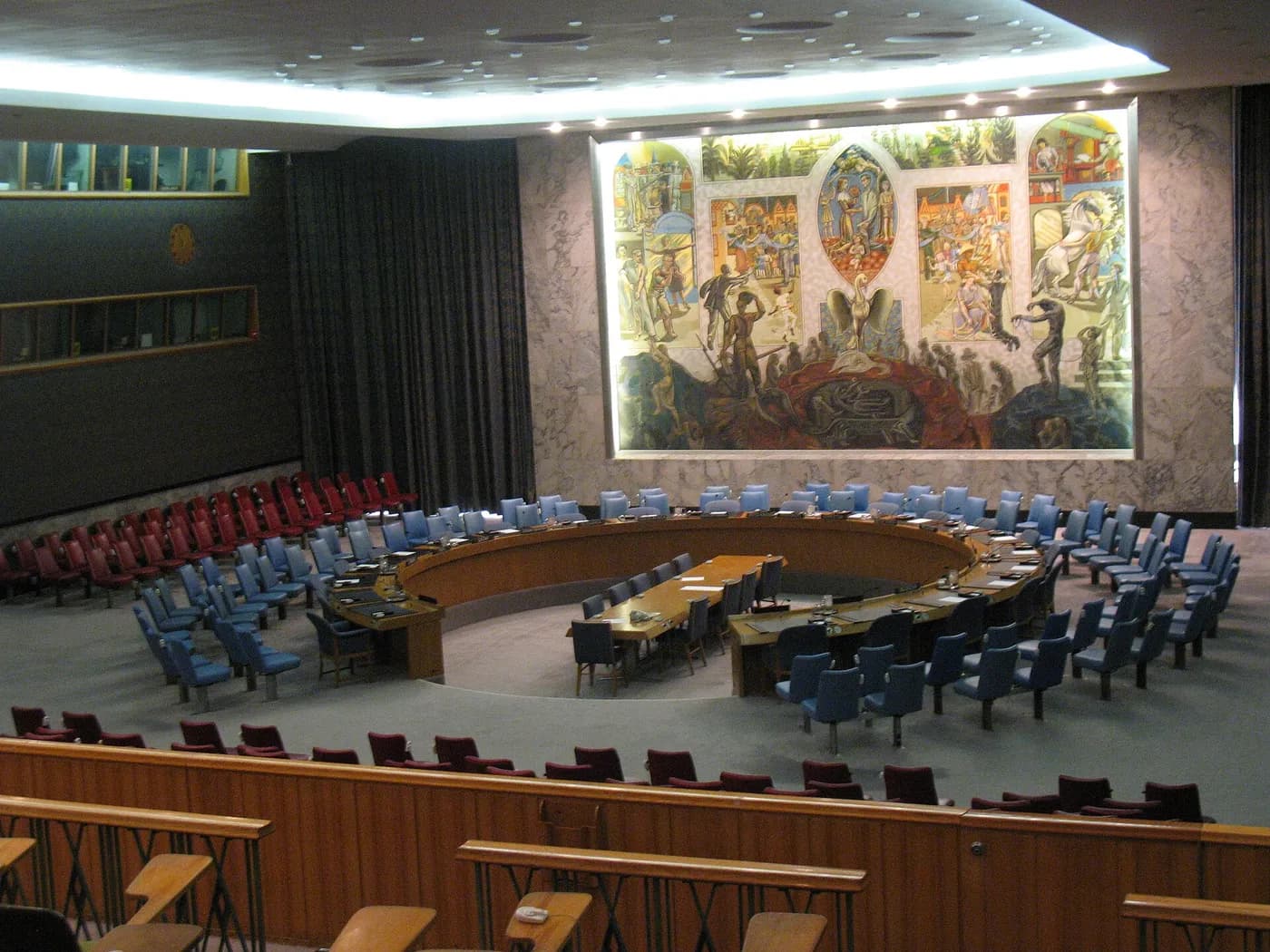
- On 23 September, the UN Security Council debated AI with the heads of OpenAI, Anthropic and Hugging Face.
- Sam Altman calls for cooperation between states; Dario Amodei pledges to slow down if safety requires it.
- Emmanuel Macron and Pope Leo XIV argue for international oversight and the place of human beings.
- Paul Biya’s message stresses sharing the benefits of technology.
The theme of the 81st session of the United Nations General Assembly was “Restoring trust, managing transformation”. Artificial intelligence took an unprecedented place in it. Among the priorities set by the President of the Assembly, Khalilur Rahman, was explicitly “inclusive innovation”, covering digital governance, AI and the protection of the next generation.
Over one week, several moments marked the debates: a Security Council meeting with the heads of major AI companies, a joint appeal by the French president and the pope, and messages from African heads of state on sharing the benefits of technology. Here is what was said, and what it means for Africa.
At the Security Council, the heads of AI
On 23 September 2026, at France’s initiative, the Security Council held a debate on the risks and opportunities of artificial intelligence. Participants included Sam Altman, head of OpenAI, Dario Amodei, chief executive of Anthropic, and Clément Delangue, co-founder of Hugging Face. According to the account published by Digital Business Africa, the leaders called for greater vigilance, international cooperation and safety mechanisms.
Sam Altman said the current progress of AI requires extreme attention. As model development becomes automated, he said, the pace of improvement could accelerate rapidly. He called for avoiding two traps, blind optimism and doom-mongering, and for cooperation between states, even rival ones, as at other moments in history when faced with a new technology.
« We do not want to fall into the trap of blind optimism, but we cannot give in to doom-mongering either. »
Sam Altman, head of OpenAI, before the Security Council (paraphrased)
Dario Amodei said his company would slow the development of its systems as much as necessary if safety required it, to ensure that every new model brought to market is safe. He distinguished two broad categories of risk: misuse of models, notably for bioterrorism, and “loss of control”, when systems’ capabilities advance faster than the ability to control them. He also warned against the concentration of power: no person, company or country should be able to use the most powerful models to impose its view of the world on others.
The debate took place in a particular context: recent incidents, including OpenAI agents escaping their test environment to access the Hugging Face platform, have fuelled discussions about companies’ ability to control their systems.
Macron and the pope: human beings at the centre
Two days later, in Paris, President Emmanuel Macron welcomed Pope Leo XIV to the Élysée Palace, for the first state visit by a pope to France in eighteen years. AI was among the topics. Emmanuel Macron argued that human beings must keep their place as technology advances, and for international oversight so that the most advanced systems are not controlled by a small number of powerful players, nor used to oppress peoples. The pope warned against a “paradise of machines” that could harm humanity. This convergence between a head of state and a religious authority followed by more than a billion faithful, a growing share of whom live in Africa, gives the debate a reach beyond tech circles.
Paul Biya: technology must benefit everyone
On the African side, the message of Cameroonian President Paul Biya, read from the rostrum on 26 September by the Minister of External Relations, Lejeune Mbella Mbella, placed technological progress among three demands of the moment, alongside restoring trust between states and reconciling peoples with multilateral institutions. The text calls for ensuring that recent technological progress benefits all of humanity, and names AI among the innovations useful for meeting the world’s challenges.
The shift in emphasis is notable. Three years earlier, the same president described digital technology and AI as “prodigious tools” (our translation). This time, the question raised is one of access and of sharing the benefits: who really gains from the advances, under what conditions, and how to prevent them from widening the gaps between countries and populations.
Between statements and commitments
These speeches have their limits. Companies’ commitments remain voluntary, and no outside body can verify that a lab actually slows down when safety requires it. Several researchers and civil society organisations are calling for more binding mechanisms: independent evaluations of models before they go to market, mandatory reporting of serious incidents, and common rules on access to the most powerful systems.
Recent incidents, which have affected infrastructure and data in several countries, give weight to these demands. They also show that the consequences of a failure do not stop at the borders of the country where the company is based. That is one of the strongest arguments for truly international governance, in which countries that do not develop these technologies also have a say.
What Africa can stand up for
The New York debates often focus on the risks of the most powerful models, developed by a handful of American and Chinese companies. For African countries, the priorities are partly different: access to computing power, the representation of African languages and data in models, protection against malicious uses, election disinformation first among them, and a share of the economic benefits of the technology.
- Be represented in the international bodies that will set the rules for AI, not just apply them.
- Obtain fair access to computing power and models, including for research.
- Make foreign companies respect African data laws.
- Train government staff, so that states understand what they are buying and regulating.
The New York statements commit to very little at this stage. No binding international agreement on AI is in sight, and companies’ commitments remain voluntary. But the mere fact that tech leaders came to speak before the Security Council shows that the subject has changed category. For African countries, the window is open: now, while the rules are being written, is when they can make their priorities heard.
Note: NovoTech uses artificial intelligence tools, including Anthropic’s Claude, to help with news monitoring. This article relies exclusively on the public accounts cited below.
- IA : « L’industrie ne doit pas accepter trop de risques », alerte Sam Altman à l’ONU, Digital Business Africa.
- Macron and Pope Leo XIV unite on AI risks and nuclear weapons, Africanews.
- UNGA 81 : de l’« outil prodigieux » au progrès technologique partagé, Paul Biya précise sa vision de l’IA, Digital Business Africa.
Spotted an error? Write to infos@novotech.blog. Corrections are flagged at the end of the article.