Solar mini-grids in Nigeria: the technology has proved itself, the financing has yet to be invented
180 mini-grids, 146,000 households connected: the electrification programme has shown that decentralised solar works. But the naira’s devaluation sent costs soaring, and a new $300 million fund must prove that private investment can be attracted.
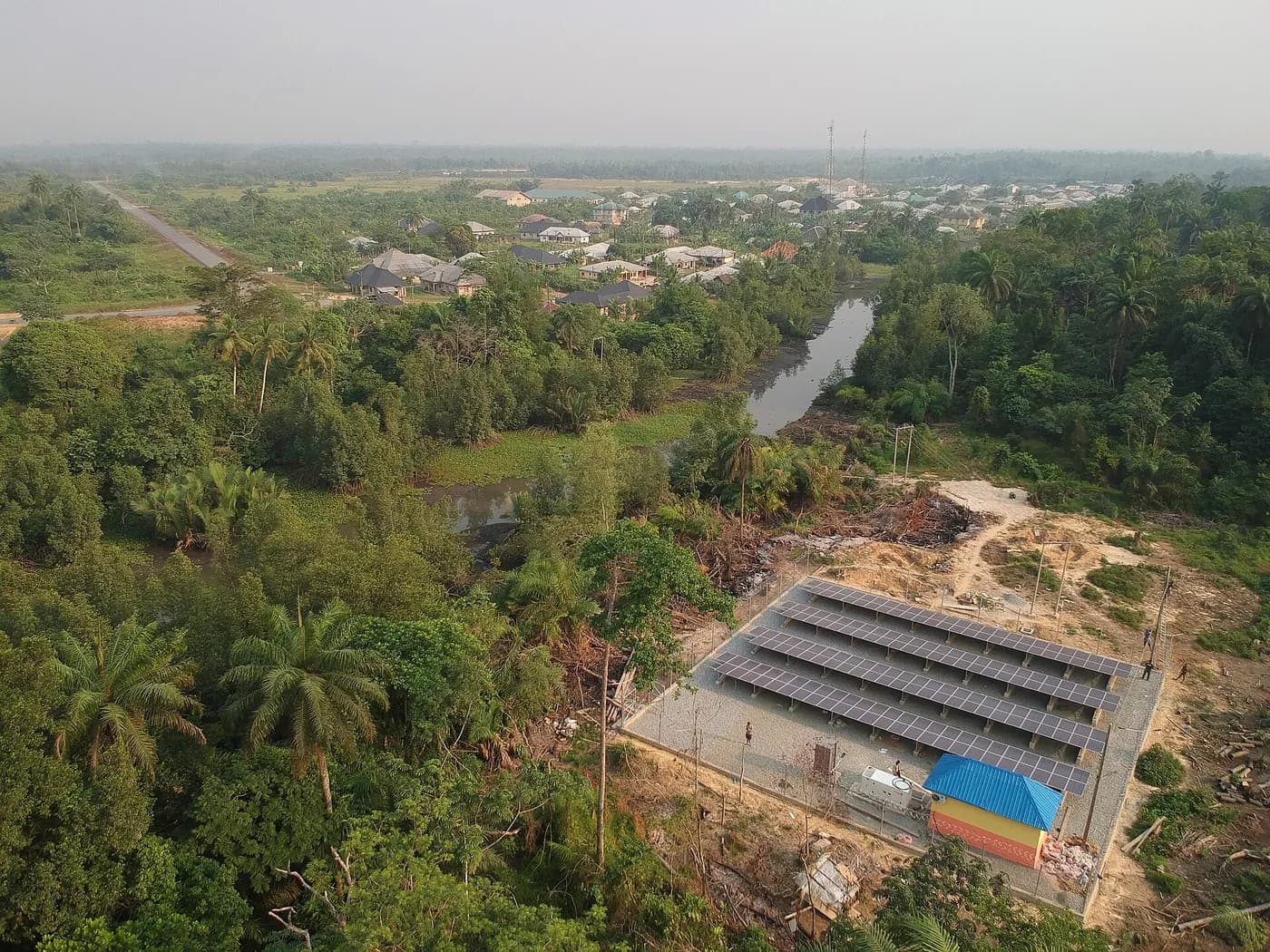
- Nigeria’s electrification programme has built 180 solar mini-grids and connected more than 146,000 households.
- Households spend nearly twice as much on generator fuel as on grid electricity.
- The naira’s depreciation pushed the subsidy per connection from $350 to $600, then $450.
- A new $300 million fund (NSIA, Africa50) is meant to attract private investment; its results have yet to be shown.
In Nigeria, electricity remains a luxury for much of the population. In 2024, only 62.5% of people had access to it, leaving more than 80 million without power. Millions of others, connected to the national grid, suffer outages so frequent that they depend on generators. Solar mini-grids, small power plants that supply a village or neighbourhood without going through the national grid, are one of the most promising answers. The country has shown that they work. It now has to find out how to finance them at scale.
What the programme has proved
Under the World Bank-backed Nigeria Electrification Project, private developers have built 180 hybrid solar mini-grids in 23 states. They have connected more than 146,000 households and installed 19.2 megawatts of renewable capacity. Technically, the bet has paid off: decentralised solar can bring electricity where the national grid does not reach, and do so reliably.
- 180 hybrid solar mini-grids built.
- 23 states covered.
- More than 146,000 households connected.
- 19.2 MW of renewable capacity installed.
Households already paying dearly for energy
The economic argument is powerful. According to a National Bureau of Statistics (NBS) survey published for 2024, the households surveyed spent 327.05 billion naira, about $246 million, on petrol and diesel for their generators, against 175.05 billion naira on grid electricity. In other words, Nigerian families spend nearly twice as much producing their own electricity, noisy, polluting and expensive, as they do buying it from the grid.
Energy spending by surveyed households (2024)
In bn ₦. Source: NBS, residential energy demand survey, via TechCabal
So the money already exists: it is simply being spent in the worst possible way. Part of it could pay for cleaner, more predictable solar electricity, provided the installations get built. That is where things get complicated.
The currency trap
The programme revealed a structural weakness: currency risk. Developers buy most of their equipment, panels, batteries, inverters, in foreign currency, but earn their revenue in naira. When the naira depreciated sharply, equipment costs soared while the tariffs paid by customers could not keep up.
The programme initially offered a subsidy of $350 per connection. To offset exchange losses, the World Bank raised it to $600. But the total envelope available fell from $150 million to $56.7 million, which reduced the number of connections financed despite higher support per unit. The subsidy was finally set at $450. These successive adjustments show the limits of a model that depends on subsidies.
How a mini-grid makes money
A mini-grid’s business model is simple on paper. The developer builds the solar plant, with batteries and often a small backup generator, then a local distribution network to homes and shops. Customers pay for their electricity, usually in advance, with prepaid meters and top-ups by phone. Revenue has to cover operations, maintenance and repayment of the investment over many years.
Profitability depends on consumption. A village where electricity is used only for lighting and charging phones consumes little, and revenue stays low. A village where welding workshops, grain mills, cold rooms or hair salons use electricity during the day turns the mini-grid into a viable business. That is why developers increasingly try to encourage these productive uses, sometimes by financing their customers’ equipment themselves.
The banks are not following
Beyond aid programmes, commercial credit remains hard to obtain. A developer quoted by the outlet TheCable, Hakeem Disu of Lihon Energy, sums up the problem: conventional bank loans are ill-suited to mini-grids. Their terms are short, their rates high, and the collateral required is heavy. Yet a mini-grid pays for itself over many years, at the pace of electricity bills paid by modest households. The mismatch between the length of loans and the payback period blocks projects.
From grants to blended finance
Public policy is changing accordingly. Rather than subsidising each connection, it is seeking to reduce risk in order to attract private investment. The DARES programme, worth $750 million with World Bank support, aims to mobilise more than $1 billion of private capital by tackling systemic risks rather than handing out subsidies.
The new Nigeria Distributed Renewable Energy Fund (DRE Fund) goes further. Jointly managed by the Nigeria Sovereign Investment Authority (NSIA) and Africa50, the infrastructure investment platform backed by the African Development Bank, it finances mini-grids, commercial solar systems and other decentralised installations. It starts with $25 million contributed by the World Bank, towards a target of $300 million. It was originally conceived at $500 million.
The idea is to put public money where it unlocks the most private money: by taking on part of the risk, public capital makes projects acceptable to institutional investors, such as pension funds, which would not finance a mini-grid on their own. A subsidy finances a project; a well-structured fund can create a genuine asset class, able to attract capital continuously.
The test: will the money really flow?
For now, it is a promise. The fund’s commercial launch does not yet say how much private capital has been raised, how many developers have been financed, or how many projects will be supported. The real measure of success will not be reaching the $300 million target, but durably mobilising institutional investment in decentralised energy.
To get there, developers need suitable financing: long terms, protection against naira fluctuations, and repayments matched to their local revenue. If the fund achieves this, developers will be able to build project portfolios, establish revenue track records, and become more attractive to private investors. For households and businesses, it would mean reliable, clean electricity, and less money burned in generators.
A lesson for Africa
The Nigerian case applies to the whole continent. Grant-funded solar electrification programmes have demonstrated their technical effectiveness in Nigeria, Kenya, Tanzania and Sierra Leone. But no country will be able to electrify tens of millions of people with subsidies alone. Moving to financing able to mobilise local savings and institutional investors, in local currency, is the condition for scaling up. Nigeria, with the world’s largest electricity access deficit, will be the most closely watched testing ground.
- Nigeria can build solar power plants, but funding remains elusive, TechCabal.
- Nigeria Electrification Project, Rural Electrification Agency.
Spotted an error? Write to infos@novotech.blog. Corrections are flagged at the end of the article.