A third of Senegal’s university students have never heard of generative AI, UN-CHK report finds
Presented in Dakar on Friday, a report by the Cheikh Hamidou Kane Digital University, based on 5,037 students and 159 lecturers, is the first national snapshot of generative AI in Senegalese higher education. It finds the tools firmly embedded among those who know them, and a third of students left out.
Why it mattersIf generative AI becomes an everyday study tool, students who have never encountered it start behind. The report shows who they are and calls for clear rules in every course.
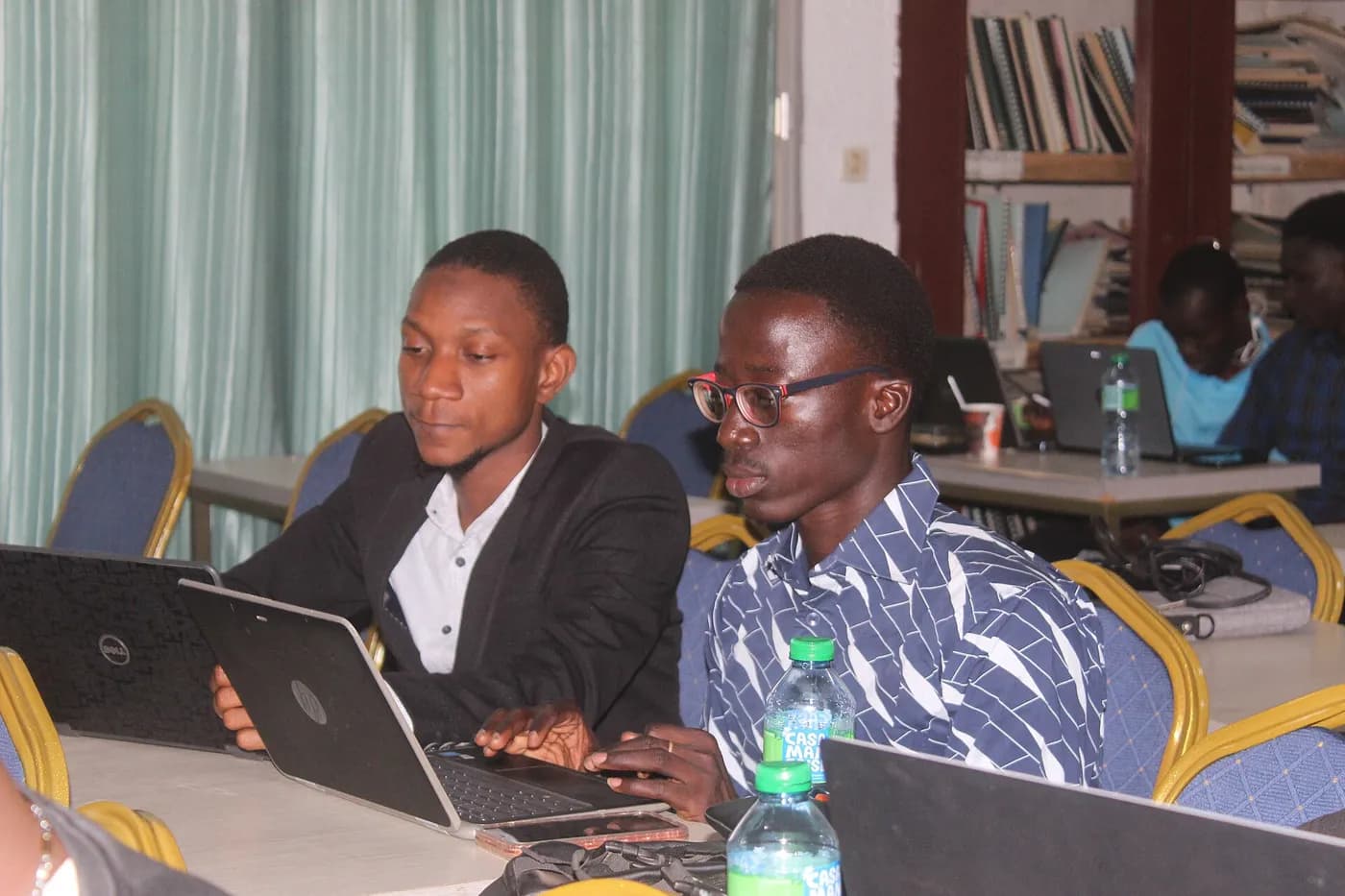
- A UN-CHK report presented in Dakar on October 16, 2026, based on 5,037 students and 159 lecturers, finds that 33.7% of students do not know what generative AI is.
- Among those who do, 77.6% have used it, roughly one student in two overall, mostly for research and writing assignments.
- Students unaware of it are concentrated outside Dakar, in non-science subjects and in first year; UN-CHK, an online university, has the lowest awareness rate (56.7%).
- More than half of lecturers neither allow nor ban AI; the report calls for a national framework and clear rules in every course.
In April, Maguette Dieng, director of academic affairs at Cheikh Anta Diop University in Dakar, told the national news agency APS that there was simply no data on how students and staff were using AI. Six months on, the numbers are in. The first one is a surprise: 33.7% of the students surveyed do not know what generative AI is.
The report, titled “Between adoption and concern: generative AI in Senegalese higher education,” was presented on Friday, October 16, by the Cheikh Hamidou Kane Digital University (UN-CHK). It comes from the university’s ALIVE research group, a lab funded by Canada’s International Development Research Centre (IDRC) under the AI4D programme it runs with the UK. According to Socialnetlink, the 324-page document was led by Seydina Moussa Ndiaye, with Abdoul Alpha Dia and Awa Doucouré. The survey covers 5,037 students and 159 lecturers at UCAD, Gaston Berger University in Saint-Louis, the universities of Bambey, Ziguinchor, Thiès and Sine-Saloum, Amadou Mahtar Mbow University, UN-CHK itself, and a number of specialised institutes and private schools.
One student in two has used it
Among those who know it (66.3% of students, 86.2% of lecturers), the technology is already a habit: 77.6% of those students and 80.3% of those lecturers have used it. Across the whole sample, that works out to roughly one student in two. Use is overwhelmingly academic: 89% of student users rely on it for their studies, first to look things up (57.4% use it often for research), then to write assignments (44%).
The remaining third is not randomly spread. It is concentrated outside Dakar, in non-science subjects and among first-year students, and 56.2% of it is female, though the share of women in the overall sample is not known. In a twist, UN-CHK, a fully online university, has the lowest awareness rate of any institution, at 56.7%. The report puts this down to its students often living in poorly connected areas. “Being digital is not enough. Access to a tool does not guarantee that people make it their own,” said Samuel Ouya, the university’s rector, as quoted by Socialnetlink.
Lecturers who will not decide
On rules, the picture is murky. More than half of lecturers (53.3%) neither allow nor forbid AI in their courses, and 35.8% of students say instructions vary from one lecturer to the next. The authors point to “an almost universal absence of institutional frameworks” and a situation in which, they write, “everyone knows AI is being used, but nobody talks about it openly.” Another limitation, flagged by 52.1% of lecturers: answers that fit local realities poorly.
The report asks the government for a national framework for higher education that builds on the National Artificial Intelligence Strategy adopted in 2023, and asks every lecturer to set out the rules for AI use course by course. Without intervention, the authors see “spontaneous and uneven adoption” as the most likely short-term scenario, one that, according to Abdoul Alpha Dia, risks “widening inequalities.”
Several methodological details remain unknown: the published accounts do not say when the survey was carried out, how responses were collected or how the sample was built, and the report itself was not yet available online on Sunday.
- IA générative : 33,7 % des étudiants ne la connaissent toujours pas, malgré son adoption croissante dans les universités sénégalaises, Socialnetlink.
- Un rapport éclaire les usages et les perceptions de l’IA générative dans l’enseignement supérieur sénégalais, APS.
- Universités sénégalaises, l’IA fait consensus, ses usages divisent, SenePlus.
- Sénégal : à l’UCAD, l’introduction de l’IA dans les enseignements séduit mais interroge, APS (AllAfrica).
- AI Living Lab for Innovative and Viable Ethical Policies and Systems (ALIVE Lab), CRDI.
Spotted an error? Write to infos@novotech.blog. Corrections are flagged at the end of the article.