AI in African languages: the real bottleneck is no longer computing power, it is data
South African startup Vambo AI trained MORENA, a model covering twelve African languages, on a supercomputer lent free of charge. The hardest part was finding text. A lesson for the whole ecosystem.
- Vambo AI (South Africa) trained MORENA, a 1.5-billion-parameter model covering twelve African languages.
- The computing power was donated (CINECA’s Leonardo supercomputer, via UNDP); the real obstacle was the lack of text.
- Much of the data is synthetic, with grammar that is sometimes imperfect.
- The weights are released under the Apache 2.0 licence so that other developers can adapt it.
When South African startup Vambo AI set out to build MORENA, a 1.5-billion-parameter artificial intelligence model covering twelve African languages, it solved the problem everyone thought was hardest: computing power. Thanks to a programme backed by UNDP, it gained access to a supercomputer. The real obstacle came next: finding enough written text in these languages.
« Finding that much real data was almost impossible, so a large part of it was synthetic. »
Isheanesu Misi, co-founder and CTO of Vambo AI, to TechCabal (paraphrased)
One model for twelve languages
MORENA covers chiShona, Kiswahili, Hausa, Yoruba, Igbo, isiZulu, isiXhosa, Kinyarwanda, Setswana, Afrikaans, isiNdebele and Nigerian Pidgin, as well as English, French and computer code. According to its documentation, it was trained on 251.7 billion tokens, of which 65.6 billion were in African languages.
Vambo chose to train its model from scratch rather than adapt an existing one. The reason: general-purpose models often inherit weaknesses in the way they split and process African languages. The result, according to the company, is a model that performs well on African text: across the twelve languages, MORENA achieves the best language-modelling score among 26 models tested, including much larger ones.
A technical detail illustrates what is at stake. An AI model splits text into small pieces before processing it, and each piece has a computing cost. MORENA’s tokeniser represents African text with 1.39 times fewer pieces than that of Google’s Gemma 3 model, and 1.53 times fewer than that of Meta’s Llama 3.2. For a user, that means faster and cheaper responses in these languages.
MORENA’s training data
In billion tokens. Source: Model documentation, via TechCabal
A donated supercomputer
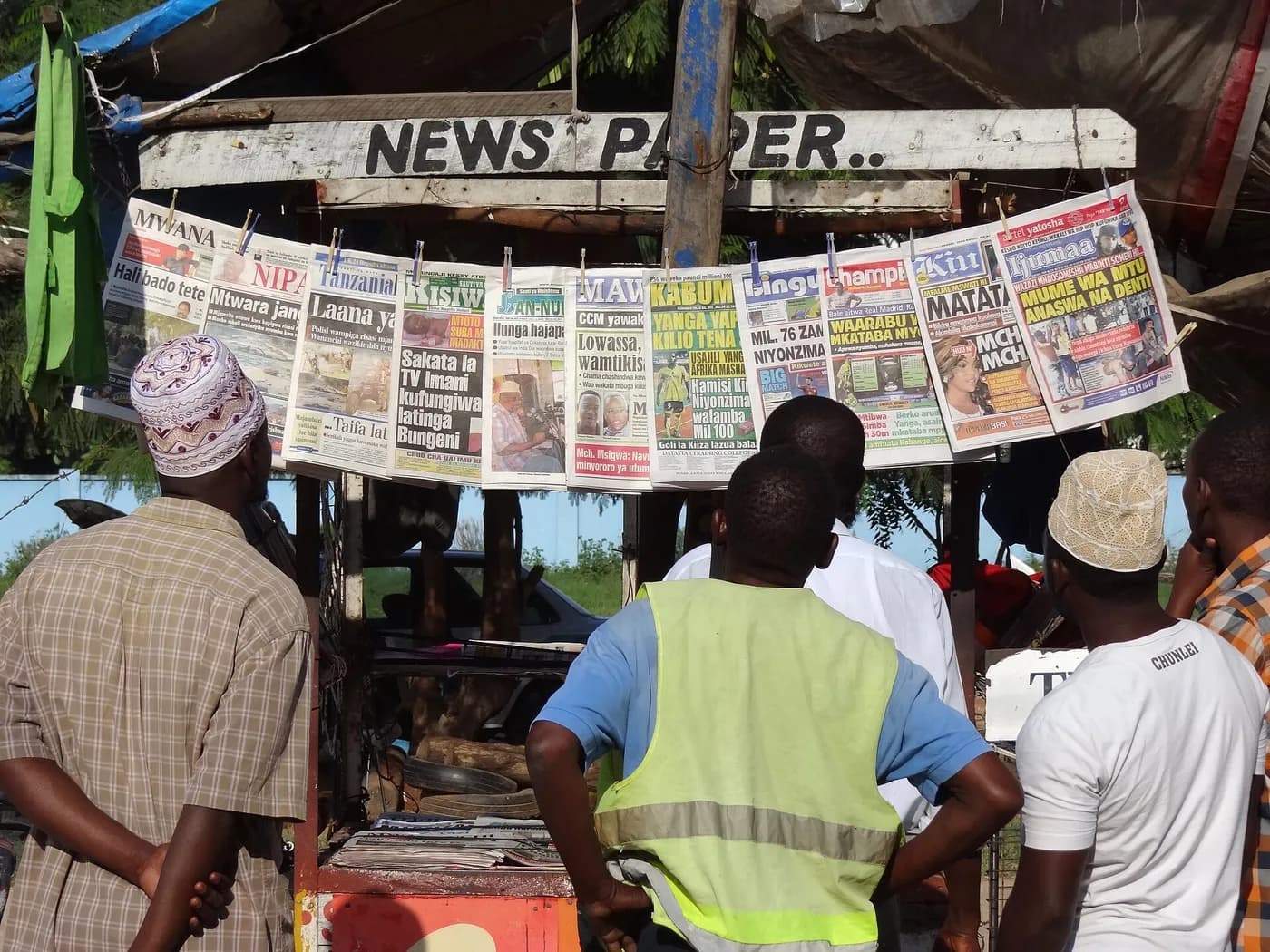
Vambo paid nothing for computing power. The Italian university consortium CINECA, which specialises in high-performance computing, gave it access to its Leonardo supercomputer through UNDP’s AI Hub for Sustainable Development. Some training runs used 512 graphics processors at once. The 22,000 hours of computing used would have cost between $25,000 and $40,000.
Without that access, Isheanesu Misi acknowledges, the project would never have got off the ground. That is also its limit: how many African teams can count on such support? Whether this kind of project can be reproduced without subsidised computing remains an open question.
Synthetic data, a stopgap
To make up for the lack of real text, Vambo relied heavily on synthetic data, meaning text generated by other AI models. This helped fill the gaps and steer the model towards specific capabilities, such as tool use. But the result is not perfect: the grammar of its answers is sometimes close but imperfect, the CTO admits.
The shortfall is striking for languages spoken by millions of people. According to Isheanesu Misi, isiNdebele and Nigerian Pidgin have almost no resources for AI. Yet these are precisely the languages in which applications would be most useful, in health, education, agriculture or financial services, for people who speak neither English nor French.
Why the big models speak these languages poorly
Large AI models are trained on gigantic volumes of text collected online. Yet the internet is overwhelmingly English-speaking, then dominated by a handful of major languages. African languages, even those spoken by tens of millions of people, are barely represented, because much of their use is oral and their written texts are rarely digitised. A general-purpose model therefore learns these languages from fragments, with errors of grammar, vocabulary and tone.
The consequence is concrete: an assistant that answers correctly in English may give an approximate, or even wrong, answer in Hausa or isiZulu. For a health or agricultural information service, that is no small matter. Hence the value of models designed specifically for these languages, even smaller ones, which can outperform general-purpose giants on their home ground.
An open model, for others to build on
Vambo presents MORENA as infrastructure rather than a finished product. The model’s weights are released under the Apache 2.0 licence, which allows commercial use; the training corpus, however, has not yet been published. Smaller versions, with 0.5 and 0.2 billion parameters, are designed to run on modest machines. The idea: to let developers adapt the model to fintech or education without bearing the cost of full training.
« If everyone tries to build a model from scratch, it is prohibitive, complicated and slow. But fine-tuning can cost a hundred dollars, or even less. »
Isheanesu Misi, Vambo AI (paraphrased)
A broader movement
MORENA is not alone. The continent has more than 2,000 languages, many of them with very little digitised text or recordings. In Nigeria, the multilingual N-ATLAS model is being developed around local languages. Through its WAXAL project, Google has released an open speech dataset covering 21 languages of sub-Saharan Africa. Researchers and startups are collecting recordings and producing synthetic data to fill the gaps.
Computing power, meanwhile, is becoming more accessible. In Nigeria, the UduTech platform is building a GPU computing offering and has just partnered with South Korea’s BARO AI to expand the supply of processors for African governments, businesses and researchers. The company Chipmango designs chips and trains engineers.
These initiatives also raise a question of ownership. When a large foreign company collects voice data in African communities, who keeps control of it, and who benefits from the products built on it? Open licences, such as those chosen by Vambo for its model or by Google for WAXAL, let everyone use it. But the communities that provide their voices and texts are increasingly asking to be involved in decisions and benefits, a debate African language technology researchers have been pushing for years.
The data layer, as strategic as GPUs
The lesson of MORENA goes beyond Vambo. Africa’s AI ambitions are often measured by the number of graphics processors and data centres announced. But without data, these machines run idle, or produce models that speak the continent’s languages poorly. Collecting, cleaning, documenting and sharing language data at scale is less spectacular work than opening a computing centre. Yet it is what will decide whether AI ever truly speaks to Africans in their own languages, and not only in those of their former colonisers.
- Building African-language AI is easier than finding the data, TechCabal.
- African Development Bank Launches Free AI Training for Public Officials Across Africa (AI Hub du PNUD), TechAfrica News.
Spotted an error? Write to infos@novotech.blog. Corrections are flagged at the end of the article.