Kenya and Anthropic sign an AI declaration: what it contains, and everything it does not
Signed in New York on the sidelines of the UN General Assembly, the joint declaration opens the door to projects in health, education and public administration. With no money, no timetable and no Kenyan AI law to frame it.

- Kenya and Anthropic signed a joint declaration on AI in New York on 22 September.
- Four areas: skills, research, public services, safety and evaluation; no funding and no timetable.
- Kenya’s AI strategy costs 152 billion shillings to 2030 and has no identified funding.
- The national AI policy and AI law are still being prepared; the AI safety institute does not yet exist.
- Shortly before, Anthropic had reported a Kenyan influence operation using Claude, with no link to the government.
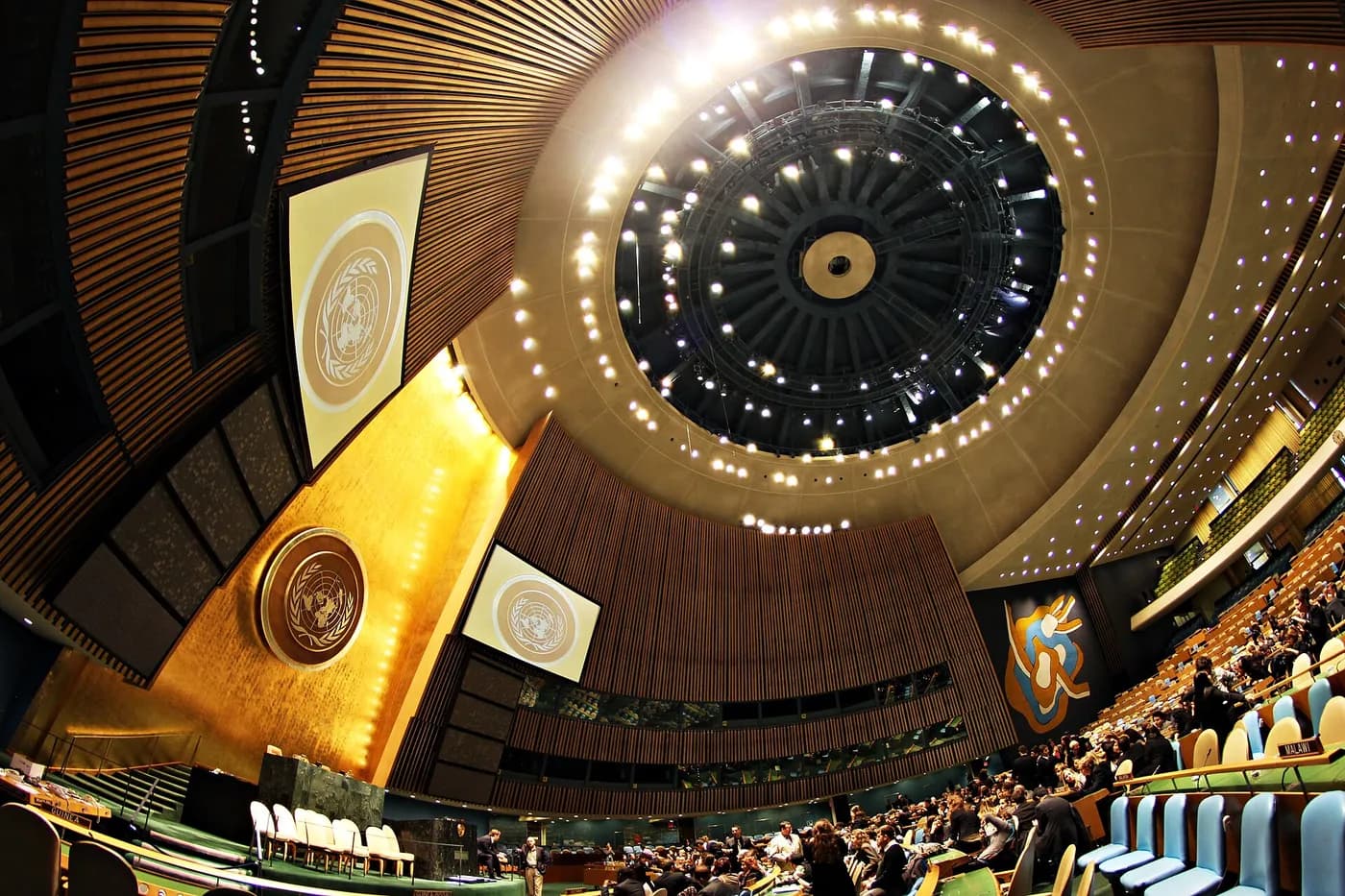
On 22 September 2026, in the corridors of the United Nations General Assembly in New York, Kenya added a name to its list of technology partners. Foreign Affairs Principal Secretary Abraham Korir Sing’Oei and Elizabeth Kelly, head of Beneficial Deployments at Anthropic, the American company that develops the Claude artificial intelligence models, signed a joint declaration of cooperation. Ambassador Philip Thigo, Kenya’s special envoy on technology, and Courtney O’Donnell, Anthropic’s head of global impact, were witnesses.
The ceremony earned flattering headlines in the Kenyan press. The text itself is more modest than the press releases that accompanied it. It is neither an investment, nor a contract, nor an acquisition, but a framework: a list of areas in which the two parties say they want to work together. To understand its real scope, it needs to be read in light of Kenya’s strategy, its funding, and an episode that took place a few days earlier.
Four areas, no figures
The declaration covers four areas: AI training and skills development, research, “responsible” uses in the public sector, and safety evaluation of AI systems. It also mentions local applications in education and health. Projects are to be designed with Kenyan institutions, tested on a small scale, then expanded if they work.
What is missing is just as telling. No sum is announced, whether for training, computing power or tool licences. No timetable is set. No pilot project is named. The outlets that had access to the text confirm it: the declaration makes future pilots, training programmes and research possible, without committing to any of them.
« Kenya has the opportunity to develop a different model of collaboration with frontier AI companies, based on co-creation, trust, safety and local skills. »
Philip Thigo, Kenya’s special envoy on technology (paraphrased)
AI diplomacy led by Foreign Affairs
The detail that strikes observers is which ministry signed. It is not the ICT ministry, but Foreign Affairs. For several months, Nairobi has treated AI as a foreign policy file. Philip Thigo opened talks with Anthropic in June 2026, before travelling to Silicon Valley to meet its chief executive, Dario Amodei. On 3 September, ICT Principal Secretary John Tanui in turn received a delegation from the company.
Anthropic is not an isolated case. In a few months, Kenya has held talks with OpenAI, Google, Microsoft, Meta, NVIDIA, Mistral and Cohere. The day before the signing, on 21 September, Prime Cabinet Secretary Musalia Mudavadi signed a five-year memorandum of understanding with Stanford University’s Hoover Institution on data, AI and public policy analysis. Again, with no financial commitment.
This strategy has a logic: multiplying partners so as to depend on none, and positioning the country as the natural entry point for AI in East Africa. It also has a limit: a pile of declarations of intent does not make a policy, as long as no budget follows.
A 152 billion shilling strategy, unfunded
The declaration says it is part of the Kenya Artificial Intelligence Strategy 2025–2030. This document identifies four pillars: infrastructure, data and research, skills, and governance. Its cost is estimated at 152 billion Kenyan shillings to 2030, about $1.17 billion. Roughly half would go to infrastructure, digital hubs, fibre optics and data centres, with a target of 1,450 digital innovation hubs across the country.
The problem, noted by several analysts, is that this strategy has no identified source of funding. Compared with the national budget for fiscal year 2026–2027, about 4.82 trillion shillings, it would represent nearly 3% of state spending over the period. The annual envelope devoted to digital, around 10.5 billion shillings, is fourteen times smaller than what the strategy calls for.
Kenya: ambition and means (billion shillings)
In bn KES. Source: AI Strategy 2025–2030, 2026–2027 budget (The Rio Times)
In this context, agreements with AI giants play a particular role: they can bring training, computing credits or tools without going through the state budget. But as long as they remain at the declaration stage, they do not fill the gap.
A legal framework still under construction
The declaration addresses the question of data: future programmes involving access to, processing or use of data will have to comply with Kenyan law, notably on data protection, cybersecurity and public sector requirements. Philip Thigo stressed data sovereignty. That law still has to exist, though. The draft national AI policy was put out for public consultation from 21 July to 4 August 2026, and its final version has no publication date. An AI bill is awaiting Parliament.
The “safety and evaluation” strand raises the same question. Kenya is considering a national AI safety institute, tasked with testing models and classifying risks. It does not yet exist. In practice, the planned evaluations will therefore take place, for now, under bilateral arrangements with the company, rather than under the supervision of an independent national authority.
The shadow of a disinformation report
The signing came a few days after Anthropic published a report on malicious uses of its models. Among the cases described was a Kenya-based actor that used Claude to produce batches of about fifty political messages designed to look spontaneous, ahead of the 2027 general election. Some praised Energy Minister James Opiyo Wandayi’s action on electricity tariffs; others claimed the opposition coalition was cracking.
According to the company, no link to the government was established, the operation was rated at the lowest level of its severity scale, and the content did not reach real users. The accounts were removed. The episode is nonetheless a reminder that Kenya is approaching cooperation with AI labs a year before an election in which these tools can also be used to manipulate opinion.
What Kenya can gain
It would be unfair to reduce the declaration to a photo opportunity. For a country that wants to train engineers, develop tools in Swahili and modernise its public services, direct access to the teams at frontier labs has real value. Health and education projects, if they materialise, can be evaluated on measurable results: diagnosis times, pass rates, time saved by staff.
But Kenya already has experience of technology partnerships announced with great fanfare that stayed at the pilot stage. The difference will come from its ability to impose its conditions: data hosted and governed locally, skills transferred rather than licences rented, and results published. The New York declaration sets out the principle. The coming months will show whether Nairobi has the means to enforce it.
Note: NovoTech uses artificial intelligence tools, including Claude, to help with news monitoring. This analysis relies exclusively on the public documents and articles cited below.
- Kenya Signs AI Cooperation Deal with Anthropic, TechMoran.
- Kenya Signs Responsible AI Declaration With Anthropic, Days After Being Named in the Company’s Threat Report, iAfrica.
- Kenya AI Public Administration Deals Signed In New York, No Money Yet, The Rio Times.
- Kenya, Anthropic Sign AI Deal to Explore Education and Public Sector Applications, Kenyans.co.ke.
Spotted an error? Write to infos@novotech.blog. Corrections are flagged at the end of the article.