Medical drones: Côte d’Ivoire moves to ten Zipline centres, and bets eight years on air logistics
After three years of operations in Daloa, the Ivorian state has approved an eight-year public-private partnership with Zipline to cover 2,200 health facilities and 12 million people. An ambitious project, whose cost to the Treasury has yet to be published.
- Côte d’Ivoire is expanding its Zipline network from 1 to 10 centres, under an eight-year partnership.
- Goal: more than 2,200 health facilities and 12 million people, about a third of the country.
- Since 2023, the Daloa centre has delivered 3.55 million products, including 2 million vaccine doses.
- A $150 million US grant funds the centres; the cost of the service to the state has not been published.
A rural health centre waiting three days for a bag of blood or a vaccine can mean a life lost. That is the problem Côte d’Ivoire wants to solve by scaling up. On 21 September 2026, the government announced an eight-year public-private partnership with Zipline, the American drone delivery company, to expand its network from one to ten distribution centres.
Once completed, the network will serve more than 2,200 health facilities and more than 12 million people, about a third of the population. The drones will carry blood products, vaccines and essential medicines to facilities that the road reaches slowly, or not at all during the rainy season.
Three years of results in Daloa
The project is not starting from scratch. Zipline has operated a centre in Daloa, in the centre-west of the country, since 2023. In three years, according to figures released by the company and the health ministry, it has delivered more than 3.55 million medical products to more than 220 facilities in five regions, including about 2 million vaccine doses and 20,500 units of blood products. Zipline estimates it has helped save the equivalent of 2,058 lives, a figure that remains the company’s own estimate.
A sector specialist sums up what is at stake: three years and 3.55 million deliveries is no longer a pilot project. It is a service, and the question is no longer whether it works, but how much it costs and who pays for it over time.
How a delivery works
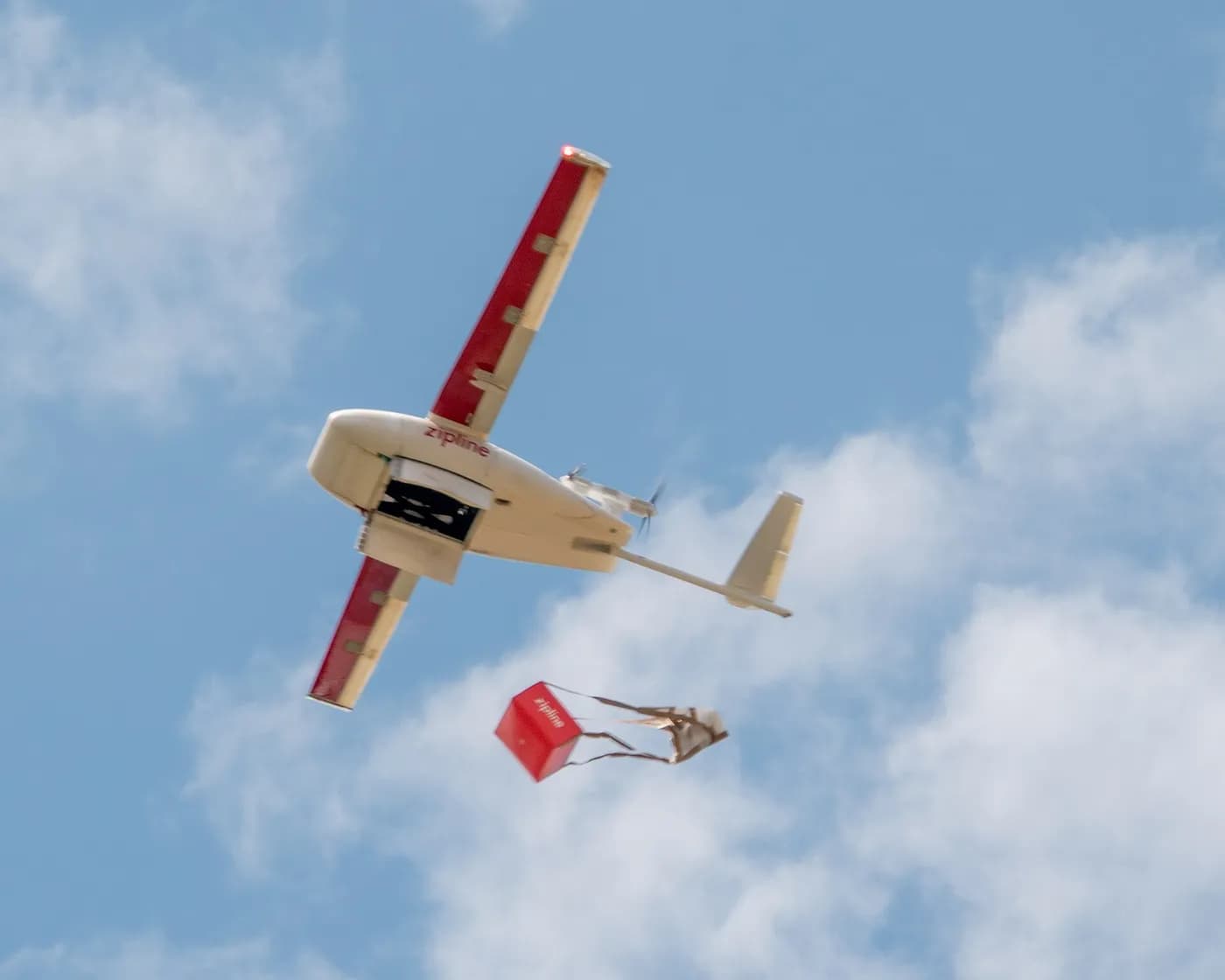
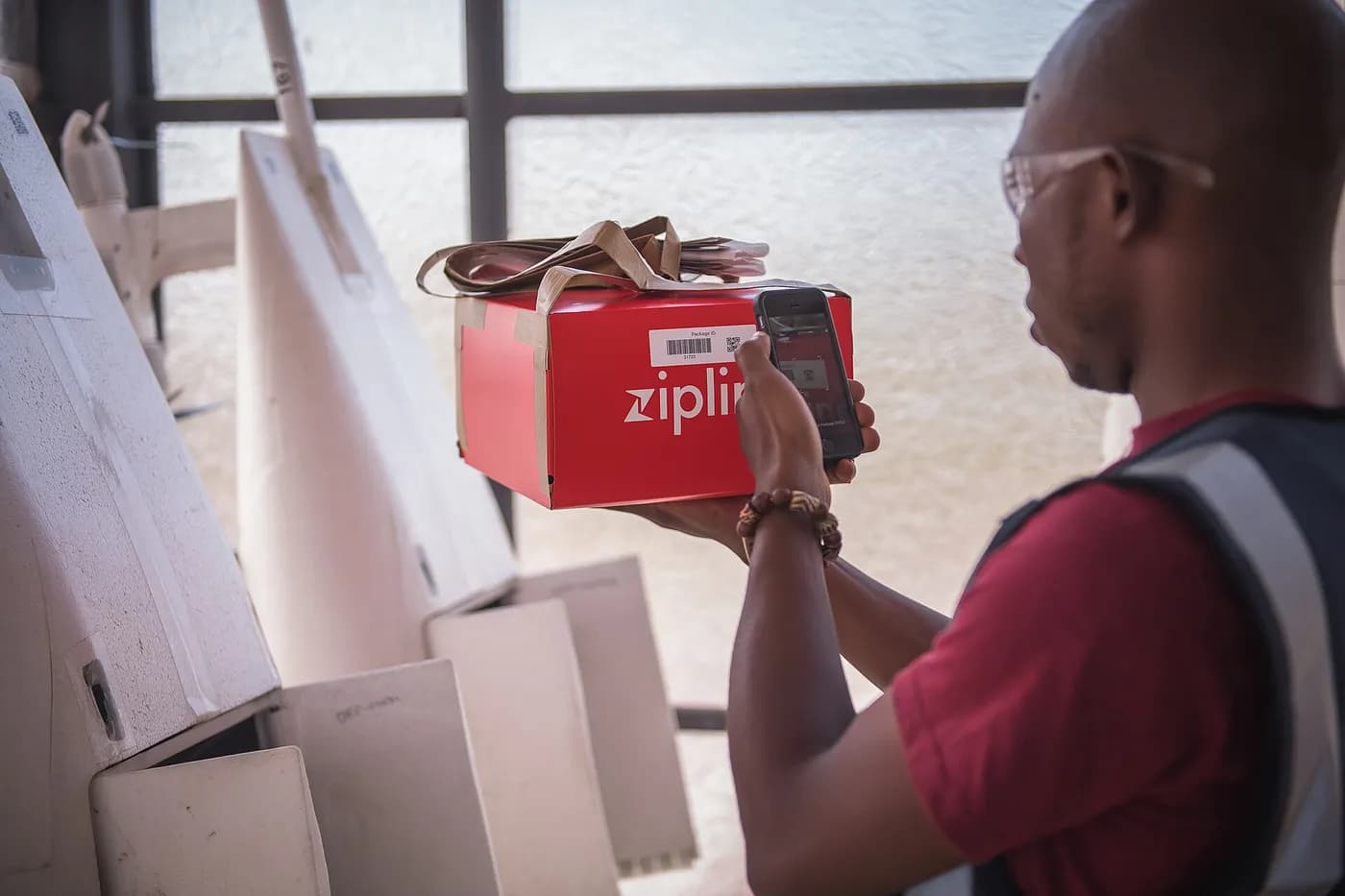
The principle is simple for health workers. A health centre that is short of a product orders it by phone or message. At the distribution centre, the team prepares the package in insulated packaging for blood or vaccines, scans it and loads it into a fixed-wing drone launched from a catapult. The aircraft flies on its own, monitored from the centre, then drops the package under a small parachute over a pre-identified area, without needing to land. It then returns to base, where it is caught, checked and recharged.
This organisation changes the logic of stock management. Rather than spreading rare and perishable products across hundreds of small facilities, with the risk that they expire on a shelf, the system keeps them in a few well-equipped centres and sends them on demand. This is particularly useful for blood, which keeps for only a short time and whose rare groups cannot be stored everywhere.
- Phase 1 (27 months): expansion around Daloa, new centres in Biankouma, San Pedro and Kouto.
- Phase 2: six more centres, in Abidjan and five other regions.
- Eventually: 10 centres, more than 2,200 health facilities, more than 12 million people covered.
Two phases, ten centres
The contract with Zipline SARL, the local subsidiary, was signed in December 2025 and made public nine months later. It has two phases. The first, over 27 months, expands operations around Daloa and opens centres in Biankouma, San Pedro and Kouto. The second adds six centres, in Abidjan and five other regions. The partnership is led by the Ministry of Health and Public Hygiene, headed by Pierre N’Gou Dimba.
« Côte d’Ivoire shows what commercial diplomacy can deliver in practice. »
Caitlin Burton, Zipline’s general manager for Africa (paraphrased)
Xavier Greusard, Zipline’s vice-president for business development in Africa, speaks of an autonomous logistics backbone run by Ivorian talent. The centres employ locally recruited technicians, flight operators and pharmacists, an argument the company highlights in every country.
American money, African customers
The financing deserves detail, because it is unusual. In November 2025, the US State Department announced a $150 million grant to Zipline, paid on results: the money only arrives if governments sign contracts. It covers five countries, Côte d’Ivoire, Ghana, Kenya, Nigeria and Rwanda, with a target of up to 15,000 health facilities. According to published information, it is used to build the distribution centres.
In return, partner governments commit to paying for the service, for cumulative fees of up to $400 million across the five countries. One sector observer sums up the logic bluntly: spending American money to create African customers. For Washington, it is a way to support a national company against Chinese competition in logistics. For African countries, it is infrastructure built partly without their budget, but a service to pay for over many years.
A 300% return, but on what basis?
Zipline and the Ivorian authorities put forward a return for the state of about 300%, taking into account medicines that did not expire, trips avoided and lives saved. The figure is attractive. It is also unverifiable as things stand: neither the company nor the government has published how much Côte d’Ivoire will pay for the service over eight years. Zipline declined to disclose the value of the contract.
This point is not a detail. An eight-year contract depends every year on the budget vote and the goodwill of the finance ministry. Nigeria has learned this: in Kaduna State, Zipline’s operations were suspended in 2025 after a change of administration, although they had delivered more than 225,000 medical products, including 154,000 doses of Covid-19 vaccine.
The Kaduna lesson applies to every country that signs. Health results are not enough to protect a service when the budget changes hands. A solid multi-year contract must provide for public indicators, clear payment terms and clauses covering late payment, or the drone stays on the ground and health centres go back to the road.
What will make it succeed
Drone delivery does not replace roads, district pharmacies or health workers. It fills a specific gap: urgent, rare or fragile products that cannot be stocked everywhere. Its value is therefore measured by simple indicators the ministry could publish: the number of stock-outs avoided, the average time between order and delivery, the blood bags destroyed because they expired, and the cost per delivery compared with road transport.
The Ivorian project has what it takes to succeed: three years of practice, announced coverage of a third of the population, and outside start-up funding. It still lacks one thing: transparency on its real cost. It is through the budget lines devoted to air logistics, far more than through launch photos, that we will know whether the eight-year bet is sustainable.
- Côte d’Ivoire and Zipline to Expand AI-Powered Health Logistics Infrastructure to 10 Distribution Hubs, Reaching 12 Million People, Zipline.
- Zipline Promises Ivory Coast A 300% Return, Not What It Costs, DroneXL.
- Côte d’Ivoire Bets on Zipline to Fix Its Health Care Supply Chain, Tech Labari.
- Côte d’Ivoire, Zipline ink $150M AI health logistics deal, The Condia.
Spotted an error? Write to infos@novotech.blog. Corrections are flagged at the end of the article.