Huawei Mate 90: a real camera that clips onto the phone, good idea or luxury gadget?
According to consistent leaks, the Collector edition of the Mate 90 Pro Max, unveiled on 1 October, would get a 10x zoom module with its own 1-inch sensor. More than an accessory: a screenless compact camera fixed to the phone. What it promises, what it would cost, and what it changes for African buyers.
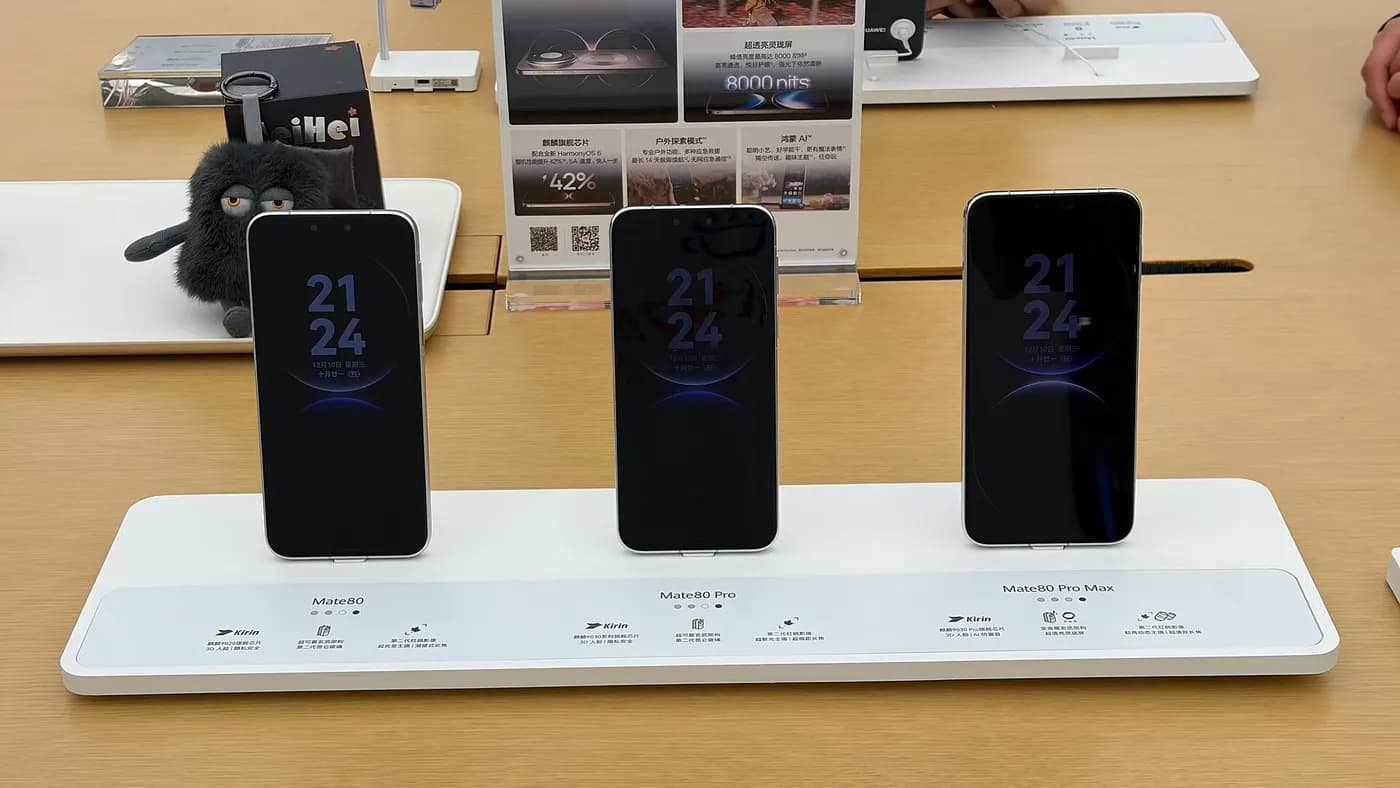
- Huawei unveils the Mate 90 range on 1 October: Mate 90, Pro, Pro Max and RS Ultimate Design.
- According to leaks, a Collector edition of the Pro Max would get a 10x zoom module (24–240 mm) with its own 1-inch sensor.
- Prices mentioned: about €1,800 for the set, nearly 1.2 million CFA francs.
- Without access to cutting-edge chips, Huawei stands out through photography, screens and batteries.
- In Africa, the lack of Google services on HarmonyOS 7 remains the main obstacle.
Every concert-goer knows the scene: you raise your phone towards the stage, push the zoom as far as it goes, and end up with a smeared image in which you can barely make out the artist. Periscope lenses, which fold light inside the body, have pushed that limit back without making it disappear. A smartphone is still an object less than a centimetre thick, and optics have their laws.
Huawei is reportedly about to get around the problem in a radical way: no longer trying to fit the zoom inside the phone, but attaching it on top. That, at least, is what several Chinese sources claim, with information that tallies, two days before the presentation of the Mate 90 range, scheduled for Thursday 1 October at 6:30 GMT (14:30 in Beijing).
Four phones, and a fifth for collectors
The Mate 90 family would include four models: the Mate 90, the Mate 90 Pro, the Mate 90 Pro Max and a top-end model called the RS Ultimate Design. Photos taken outside official channels already show a Mate 90 with a woven green back and a gold frame. Huawei is sticking with its large circular camera module, its visual signature since the Mate 30 in 2019.
The Pro Max would have a top-tier spec sheet: a Kirin 9050 Pro chip, 16 GB of RAM, a 6.9-inch dual-layer OLED screen, a 6,800 mAh battery with 100 W charging, a 50-megapixel main sensor with variable aperture, and a 200-megapixel periscope telephoto lens. All of it running HarmonyOS 7, Huawei’s in-house system.
Two technical choices deserve an explanation. The “dual-layer” screen, also called tandem OLED, stacks two light-emitting layers: each one works less hard, which gives a brighter panel that ages more slowly. The battery replaces part of the graphite with silicon, which stores more energy in the same volume. That is what makes it possible to fit nearly 7,000 mAh into a body barely more than 8 mm thick, where a high-end iPhone makes do with about 4,000 mAh. The Mate 90 and Mate 90 Pro would add a small multispectral sensor, which measures the colour of ambient light to render skin tones better.
It is a fifth variant that draws attention: a Collector edition of the Pro Max, with a mounting ring around the camera block. A module called the XMAGE Ruiying Z10 would lock onto that ring.
A screenless enthusiast compact, locked onto the back of the phone
According to the leaks, the Z10 would carry a 1-inch sensor, the size used in high-end compact cameras such as Sony’s RX100 series. Its lens would range from 9.1 to 91 mm, the equivalent of 24–240 mm in traditional photography: a genuine motorised 10x optical zoom, with an aperture going from f/2 at the wide end to f/4.5 at the telephoto end. On paper, that is a little more than the Sony RX100 VII, which stops at 200 mm.
The difference from existing accessories is significant. Since April, Huawei has already been selling a photo kit for the Pura 90 Pro Max, with a 3.3x teleconverter from the Tilta brand. That kind of lens simply magnifies the image seen by the phone’s sensor, like a magnifying glass placed in front of the lens. The Z10 would bring its own sensor, its own optics and its own zoom motor. The smartphone would only process the image and display it.
To keep everything aligned, a classic weak point of such accessories, Huawei has filed a patent in China for a locking bayonet (number CN122802614A), a mounting system similar to that of camera lenses.
The price of a camera body
No official price is known. Chinese rumours mention more than 5,000 yuan for the module alone, around 11,000 yuan for the Mate 90 Pro Max Collector, and nearly 15,000 yuan for the set. Converted into euros and then CFA francs, at the fixed rate of 655.957 CFA francs to the euro, that gives the following:
Prices mentioned in Chinese rumours (in CFA francs)
In FCFA. Source: Rumours reported by Frandroid, NovoTech conversion
For comparison, the Mate 80 Pro Max launched last November at 7,999 yuan, and the Mate 80 RS at 11,999 yuan. A set costing nearly 1.2 million CFA francs before taxes and import costs is therefore aimed at a very small clientele: people who today buy an enthusiast camera on top of a high-end phone.
What it says about Huawei
This bet on photography is no accident. Since the US sanctions of 2019, Huawei no longer has access to the most advanced chip factories: its Kirin processors are made in China using older processes. The group claims that the three-dimensional stacking of the Kirin 9050 Pro increases transistor density by 53.5% and cuts power consumption by 41%, but it cannot win the race for raw power. So it stands out elsewhere: design, screens (up to 10,000 nits announced for the Pro Max, against 8,000 for the Mate 80 Pro Max), large silicon-carbon batteries and photography.
The strategy works in its main market. In the second quarter of 2026, Huawei held about 23% of the Chinese smartphone market, up from 18% a year earlier, ahead of Apple (18%). The whole industry is in fact heading the same way: the largest sensors are moving to telephoto lenses, because a phone camera is now judged between 3x and 10x.
And in Africa?
Huawei remains a visible brand on the continent, especially in South Africa, where the specialist press reviews its flagship models: the South African site htxt.africa has just reviewed the Pura 90s Pro Max, which it considers close to excellent. But the most expensive Mate series rarely arrive through official channels: the Mate 80 Pro Max was never launched in Europe, with only the Mate 80 Pro getting an international release, at MWC. So far, nothing suggests that the Z10 module will leave China.
For an African buyer tempted by an imported model, one constraint weighs more heavily than the price: HarmonyOS 7 runs without Google services. No built-in Play Store, and no preinstalled Google apps; some banking and mobile money apps, designed for Android, may be missing or work poorly. You have to go through Huawei’s app store, or through workarounds that sellers sometimes install themselves, with the risks that entails.
Finally, there are the unknowns specific to the Z10: its weight, its battery life, its video capabilities, RAW recording, and the durability of a bayonet on an object slipped into a pocket every day. Part of the answer comes on Thursday. Until then, the module is still a leak, and its price a rumour.
- Huawei Mate 90 Pro Max : un zoom 10x amovible avec capteur 1 pouce, sérieux ?, Frandroid.
- Huawei’s Mate 90 Just Leaked in Bright Green — and the Design Says More Than the Specs, Memeburn.
- Here’s our first look at the Huawei Mate 90 series, including the Mate 90 RS, GSMArena.
- Huawei Pura 90s Pro Max Review: An Almost Great Flagship, htxt.africa.
Spotted an error? Write to infos@novotech.blog. Corrections are flagged at the end of the article.