Robot dogs in the fields: AI gets down to crop level to spot diseases and weeds
Long confined to surveillance, four-legged robots fitted with cameras and AI are starting to inspect crops, where drones and satellites cannot see well enough. A technology that is still expensive, and that also interests African agriculture.
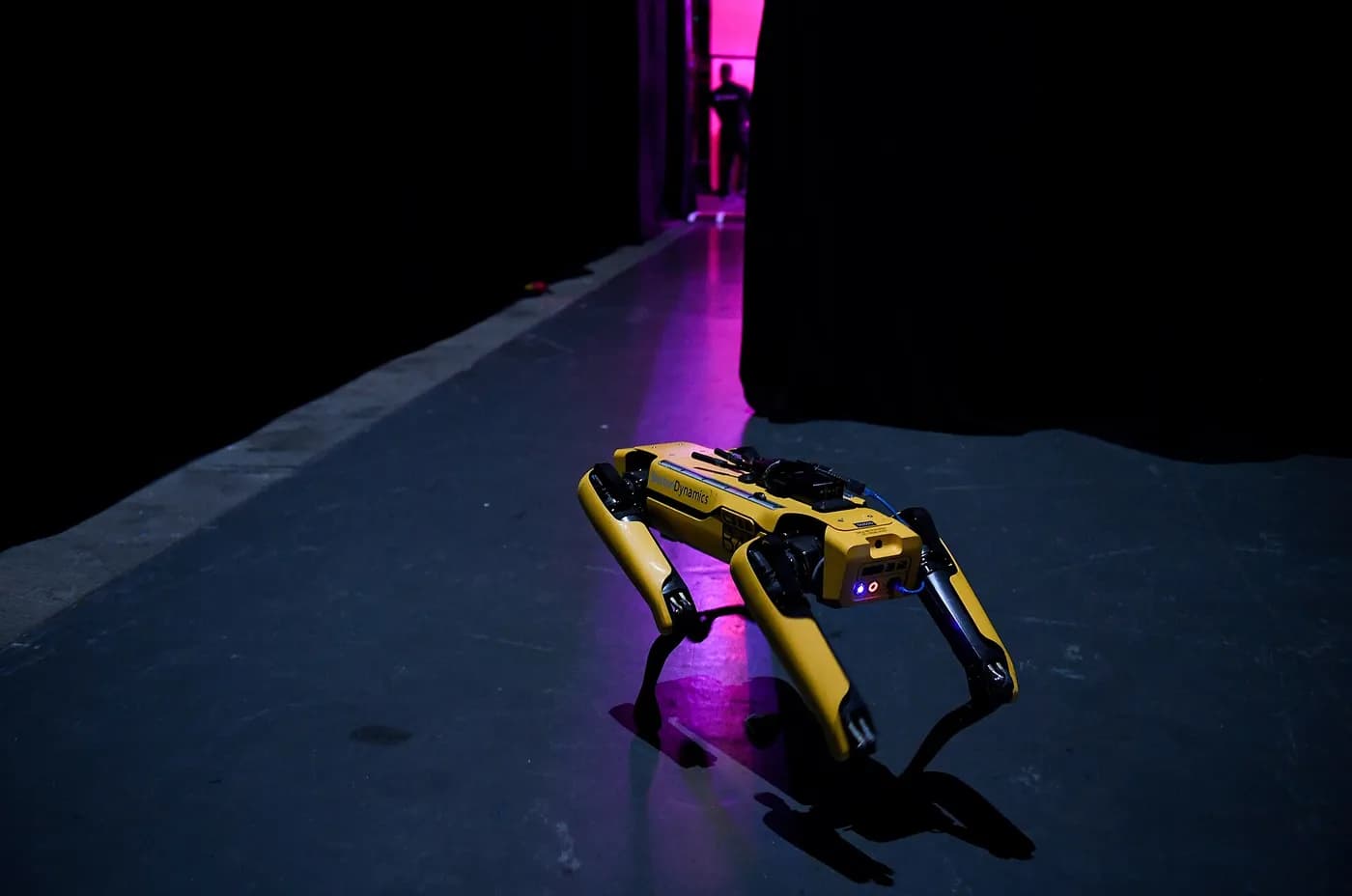
- Four-legged robots fitted with cameras, LIDAR and AI are starting to inspect crops and greenhouses.
- Syngenta and the University of Nottingham have developed a robot dog that detects weeds, diseases and pests.
- In China, DEEP Robotics claims a 70% reduction in manual labour in Turpan vineyards.
- In Africa, these robots remain expensive; mobile apps and drones are more accessible to smallholders.
Four-legged robots have mostly made headlines in security roles: patrols, monitoring sensitive sites, even borders. A new generation is turning to less spectacular but essential ground: fields and greenhouses. Fitted with cameras, laser sensors and AI vision models, these “robot dogs” inspect crops to detect diseases, pests and weeds, as the site Engadget reports.
Filling a gap in the data
Farmers already have several tools to monitor their crops. Satellites give an overview, drones fly over the plots, and inspections on foot provide the detail. But each has its limits. Satellites lack the precision to spot a sick plant. Drones are impractical in greenhouses and cannot see under the leaves. Human inspections are slow, costly and prone to oversights. As for wheeled machines, they lack the agility to move between rows without damaging the plants.
Quadruped robots offer a compromise: agile enough to move over muddy, uneven ground without crushing crops, low enough to photograph plants up close, and able to analyse images on the spot. They produce plant-level data that other tools do not provide.
Syngenta’s robot dog
Among the pioneers is the Swiss agrochemicals and seeds group Syngenta, which has developed a robot dog with the University of Nottingham. The machine is fitted with several cameras, including rotating laser scanners (LIDAR) that build a three-dimensional model of its surroundings, and high-resolution cameras that photograph the crops. It carries a graphics processor that runs computer vision models on the spot, to identify weeds, flag possible diseases and help detect pests.
« Plants talk to us in the language of light, and robot dogs are ideally placed to see those messages and let us act. »
Rob Lind, computer vision and AI researcher at Syngenta (paraphrased)
For its designers, the robot does not replace other tools: it adds to the existing toolkit, alongside satellites, drones and agronomists’ phones. Rob Lind compares the situation to the early days of agricultural drones: in five to ten years, he says, the landscape will probably be unrecognisable.
Uses are multiplying
- In the United States, farms are using robots to monitor high-value crops, with thermal cameras and real-time alerts.
- In China, the company DEEP Robotics says its robot dog can cut the manual labour of winegrowers in the Turpan region by 70%.
- Also in China, AI-equipped quadrupeds are used to detect invasive fire ant colonies.
- In Poland, Volkswagen has deployed “robot sheep” to study agrivoltaics on a solar farm.
- Several US universities (Minnesota, North Carolina A&T, Purdue) are developing their own versions.
How AI “sees” a sick plant
The principle of computer vision applied to crops is simple to explain. A model is trained on thousands of images of healthy and diseased plants, leaves attacked by insects, weeds mixed in with crops. It learns to recognise characteristic patterns: spots, discolouration, deformities, leaf shape. Once trained, it analyses each new photo and flags what looks like a problem, with a degree of confidence.
Some sensors go further than the human eye. Cameras that capture invisible wavelengths, such as infrared, can reveal a plant’s stress before visible symptoms appear. That is the meaning of Rob Lind’s remark about the language of light: a plant that lacks water or is starting to fall ill reflects light differently, and a specialised camera can detect it several days before the farmer. The three-dimensional LIDAR data measures the height and shape of plants, useful for tracking their growth.
The question of work
Robots able to work day and night could reduce the need for labour for inspections. That is a productivity gain for farms short of hands, particularly in countries where farm labour is becoming scarce. It is also a source of concern for farm workers, part of whose job could be automated. As often, the balance between productivity gains and job protection will depend on how these technologies are deployed.
Supporters of these robots put forward an argument: crop inspection is arduous, repetitive and often poorly paid work, and farms struggle to recruit. A robot doing the inspection rounds frees agronomists and workers for tasks where their judgement is irreplaceable: deciding on treatment, working on the plants, organising the harvest. Critics point out that such promises of reskilling rarely come true for everyone, and that the least skilled workers are often the first to lose their jobs.
There is also a data issue. A robot that photographs every plant produces a mass of valuable information on yields and diseases. Who owns it: the farmer, the robot maker, the seed supplier? The question already arises for connected tractors and drones, and becomes central as agriculture goes digital.
And in Africa?
Agriculture employs a large share of Africa’s working population, and losses due to diseases and pests are considerable. Fall armyworm, for example, has caused major damage to the continent’s maize crops in recent years. Detecting these threats early is therefore a major issue. But robot dogs remain expensive machines, designed first for large farms and greenhouses in rich countries.
For most African smallholders, other tools are more accessible: smartphone apps that identify a disease from a photo of a leaf, spraying drones offered as a service by local companies, free satellite data, farming advice by text message. Robot dogs could, however, find a place in large commercial plantations, agricultural research centres and export horticulture greenhouses, such as those in Kenya or Morocco.
The underlying trend is clear: artificial intelligence is coming down from the sky to the ground, and from overall analysis to the individual plant. Whether through a robot, a drone or a simple phone, it promises more precise decisions: treating only diseased plants, weeding only where necessary, and therefore using fewer chemicals. For African agriculture, facing climate change and population pressure, that precision can make the difference.
- Robot dogs on farms do a lot more than just guarding, Engadget.
- Syngenta, Syngenta.
Spotted an error? Write to infos@novotech.blog. Corrections are flagged at the end of the article.