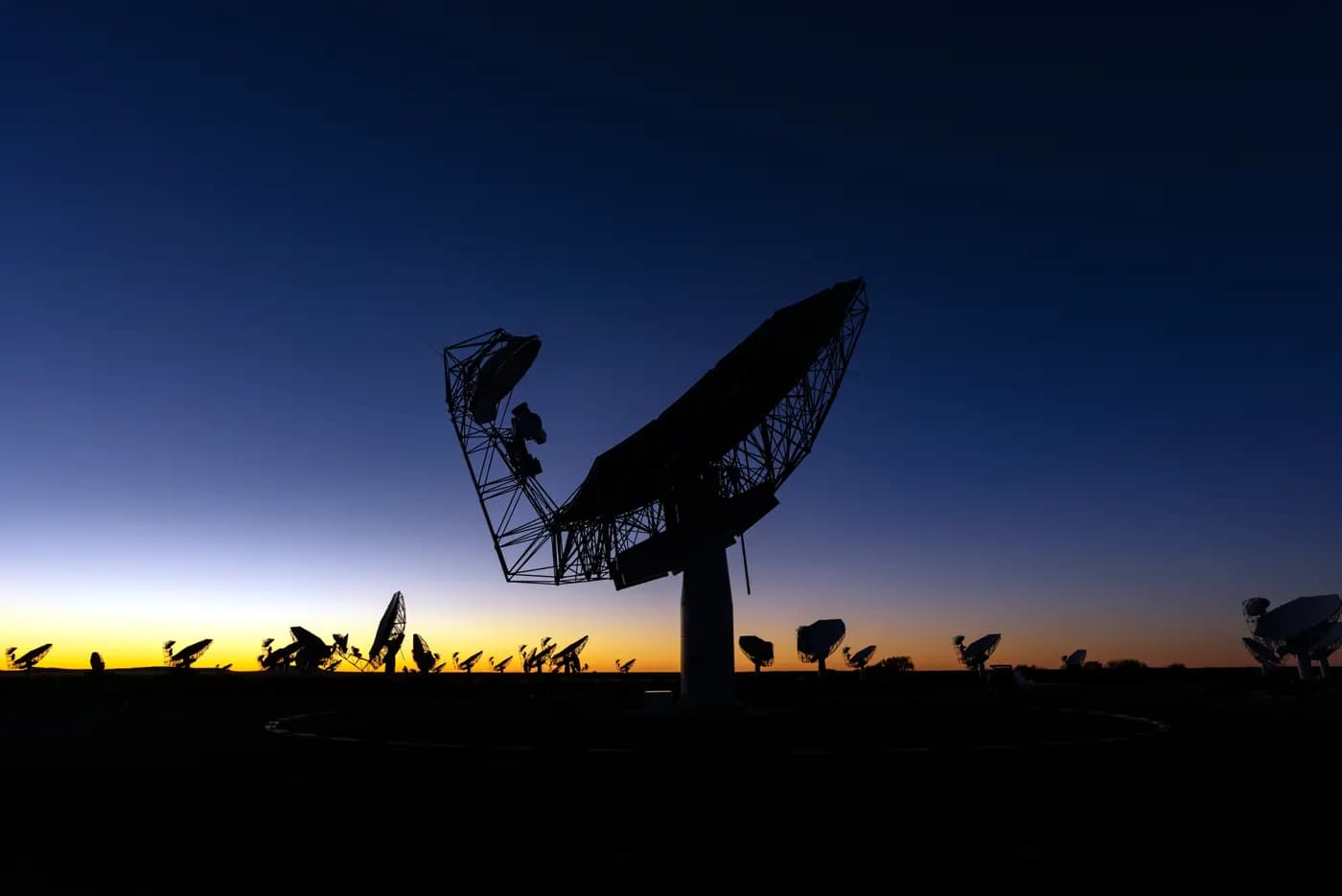
MeerKAT picks up hydrogen from a universe billions of years old
By reanalysing 96 hours of observations, South African and British astronomers have detected the faint signal of neutral hydrogen, a route to mapping matter on a large scale.
- MeerKAT has detected neutral hydrogen from a universe 4 to 5 billion years old.
- No new observations: 96 hours of existing data, analysed differently.
- A method for mapping matter on a large scale.
An international team led by astronomers from the University of the Western Cape and the University of Manchester has used the South African radio telescope MeerKAT to detect a faint radio signal emitted by neutral hydrogen. The signal travelled for four to five billion years before reaching us.
The researchers did not need new observations: they reanalysed 96 hours of data already collected by MeerKAT, using a different method, which measures the overall intensity of the signal rather than looking for objects one by one.
Why it matters
Neutral hydrogen serves as a tracer: it makes it possible to map the distribution of matter in the universe on a very large scale. The result also shows that existing data can still yield discoveries, provided it is analysed differently.
Spotted an error? Write to infos@novotech.blog. Corrections are flagged at the end of the article.