PI-SPI: how to send money from Wave to Orange Money or a bank in Senegal, free up to 8,000 CFA francs a day
Since November 2, a transfer from Wave to Orange Money, from a mobile wallet to a bank or the other way round goes through PI-SPI, the BCEAO’s platform: you create an alias, enter the recipient’s number and the money lands within seconds, free of charge up to 8,000 CFA francs sent per day. How it works, what it costs, what to do when it goes wrong and the scams to avoid.
Why it mattersIn principle, you no longer need to cash out at an agent and redeposit on the other network. But a confirmed transfer cannot be reversed, and above 8,000 CFA francs a day it may carry a fee.
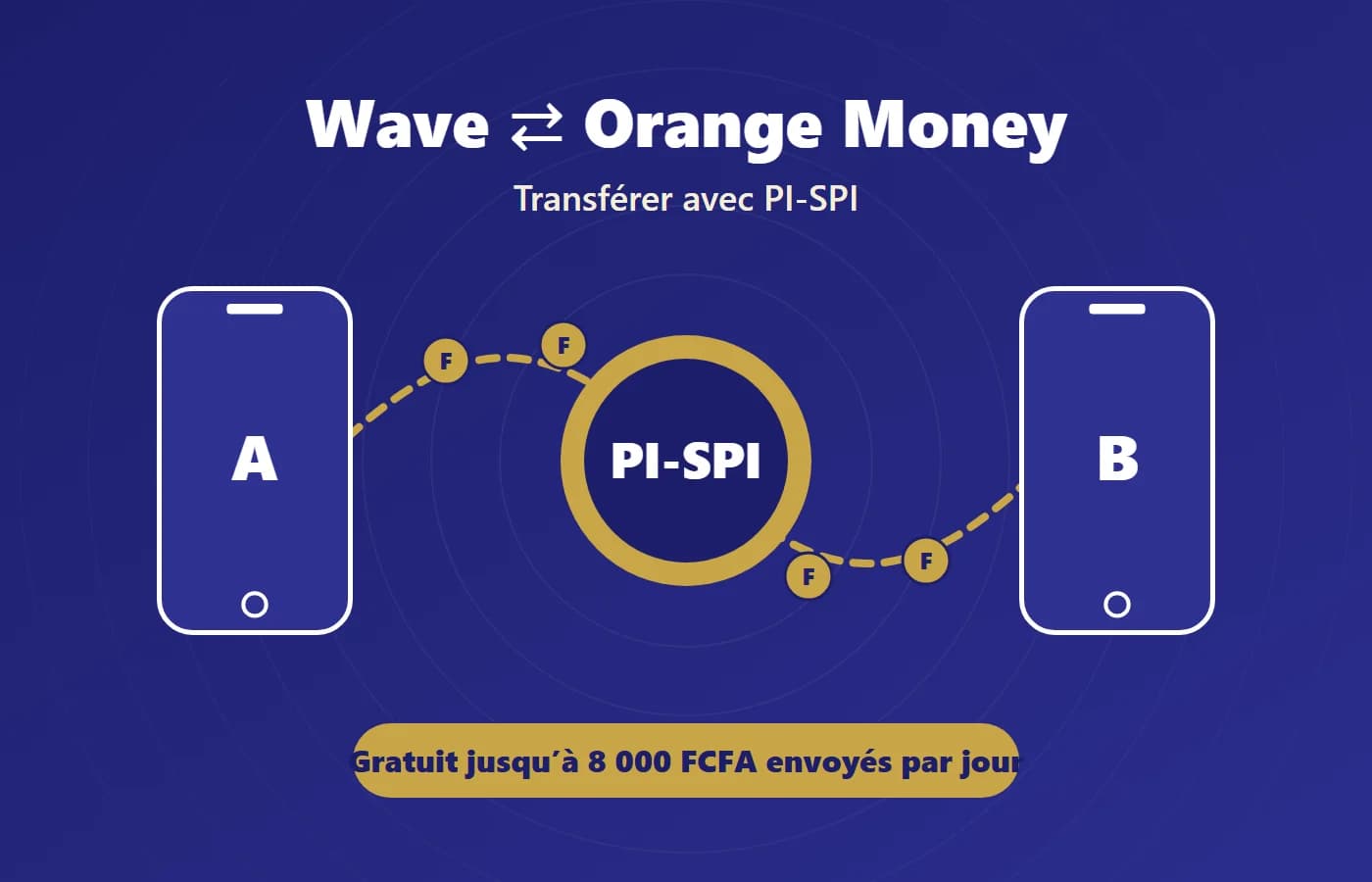
- Since November 2, 2026, every transfer between two institutions in the WAEMU, for instance from Wave to Orange Money or from a mobile wallet to a bank, goes through PI-SPI, the BCEAO’s instant payment platform.
- You send from your operator’s or bank’s app after creating an alias (a phone number or a payment address), and the money arrives in under 10 seconds, according to the BCEAO; Wave, authorised since September 30, has not publicly detailed the launch of the service in Senegal.
- Sending is free up to 8,000 CFA francs a day per institution; above that, a transfer can cost up to 0.8% before tax; receiving is always free.
- A confirmed transfer is irrevocable: check the name displayed, and if you make a mistake, ask the recipient to cancel, complain to your institution and, as a last resort, turn to the free mediation service of the OQSF.
- Never share your PIN: Senegal’s national police warn of fake apps and booby-trapped links used to drain mobile money accounts.
On Monday, November 2, customers of Senegalese banks tried, as usual, to move money from their accounts to their Wave or Orange Money wallets. Some of the transfers failed. That day, the Central Bank of West African States () made its platform mandatory for any transfer from one institution to another, and the old “Bank to Wallet” services were suspended, according to Le Soleil.
For users, the news is mostly good: you can now send money from Wave to Orange Money, from a mobile wallet to a bank or back, within seconds and without a trip to the kiosk to withdraw and redeposit, free of charge up to 8,000 CFA francs a day. That is, provided your operator has switched the service on. Here is how it works.
What is PI-SPI, and who is connected to it in Senegal?
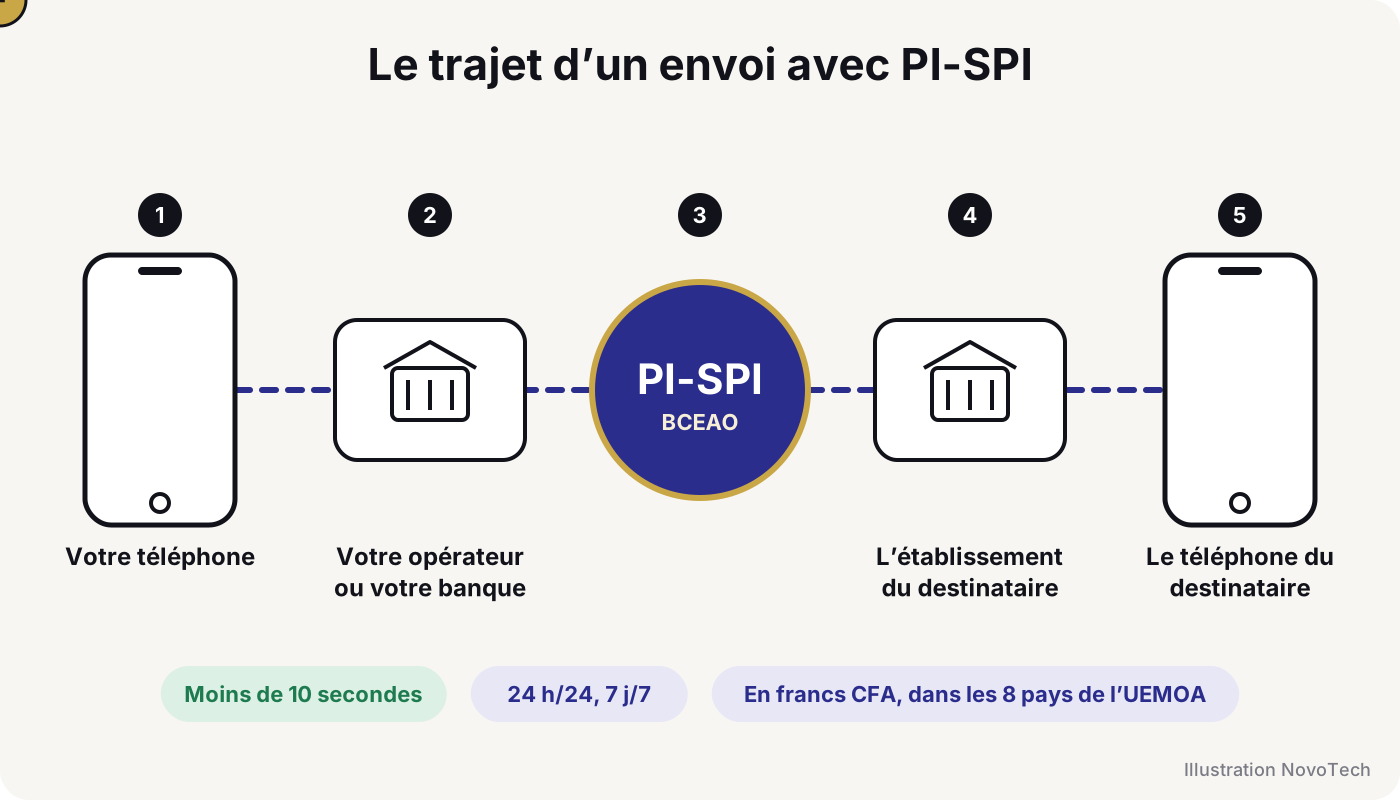
PI-SPI, short for the interoperable platform of the instant payment system, is a central switch run by the BCEAO. It routes the order from your operator or bank to the recipient’s institution, and the money is available “in less than 10 seconds”, day and night, weekends included, according to the central bank. It works only in CFA francs, between accounts held in the eight countries of the West African Economic and Monetary Union ().
Launched on September 30, 2025, the platform had 175 participating institutions a year later. In Senegal, the list drawn up by the BCEAO as of September 30, 2026 counts 43: 27 banks, four microfinance institutions and twelve issuers or payment institutions. The last group includes Orange Finances Mobiles, which runs Orange Money, Wave Digital Finance, Mobile Cash SA, the company behind Mixx by Yas (formerly Free Money), and the Djamo.
Being on the list does not mean the service is open to every customer. Wave, which joined at the deadline after a year on the sidelines, has made no public announcement about launching PI-SPI transfers in its Senegalese app and has published no instructions. Orange describes a “PI SPI” service in its Max it app, but on its Ivorian website. The sensible move: update your app and look for a PI-SPI or “instant payment” (paiement instantané) section.
How do I send money from Wave to Orange Money, or the other way round?
The BCEAO requires every participant to offer the service in its mobile app, so the process is the same everywhere, banks included; only the menu names differ. The steps below follow the BCEAO’s FAQ and the guide published by Le Soleil.
- Update the app the money is leaving from: Wave, Max it for Orange Money, Mixx or your bank.
- Open the PI-SPI or “instant payment” section. If there is none, your institution has not opened the service yet.
- The first time, create your alias: your phone number (check the +221 country code) or a payment address.
- Choose to send, then enter the recipient’s alias (often their phone number) or scan their PI-SPI QR code; if they have no alias, pick their institution and account number.
- Enter the amount and, if you like, a reference.
- Check the recipient’s first name, last name and country on screen. If they do not match, cancel.
- Look at any fee shown, then confirm with your PIN.
- The money arrives within seconds. Keep the transaction reference.
The alias is the key to the system. It replaces the account number: it is either your phone number or a “payment address” generated by PI-SPI, which reveals nothing about you. You can create only one per account, but if you choose your number, you also get a payment address. The PI-SPI QR code, recognisable by the octagon at its centre, which stands for the union’s eight countries, contains only that address, never your number.
Two precautions prevent many failed transfers. Ask the recipient to create an alias before you send money to their number. And if the app rejects your own number because it is already linked to another account, you can claim it back: the process can take up to two weeks.
No smartphone? The BCEAO lets each institution decide whether to offer USSD access, “on the pricing terms it sets”. We found no USSD code dedicated to PI-SPI published by a Senegalese operator.
« You no longer need to withdraw cash to go and deposit it. Now transactions can happen naturally. »
Souleymane Astou Diagne, economist at Alioune Diop University in Bambey, speaking to RTS (quoted by Senego)
Can I send from Wave or Orange Money to a bank account?
Yes. The “Bank to Wallet” and “Wallet to Bank” services have been suspended, and banks are steering customers towards PI-SPI, Le Soleil reports. To go from a bank to , create your alias in the banking app and send to the recipient’s number, provided they have their own alias with Wave or Orange Money. In the other direction, enter the alias linked to the bank account, or choose the bank and type in the account number.
The first days were bumpy. Some customers saw transfers to Wave, Orange Money or Flash fail, with no transition period, according to L’Observateur, as cited by Senego. One CBAO customer told RTS they had been forced to fall back on another solution. If your usual shortcut no longer works, it probably relied on a suspended service: use the PI-SPI route instead.
How much does a transfer from Wave to Orange Money cost?
The fees are set by a BCEAO statement dated October 2 and applied since November 2. Domestic transfers are free to send as long as the day’s cumulative total does not exceed 8,000 CFA francs “per user and per participant”, however many transactions that involves. A transfer of more than 8,000 CFA francs can be charged between 0% and 0.8% of its amount before tax: at most 160 CFA francs for 20,000 and 400 for 50,000. Receiving is free, with no limit on amount or number.
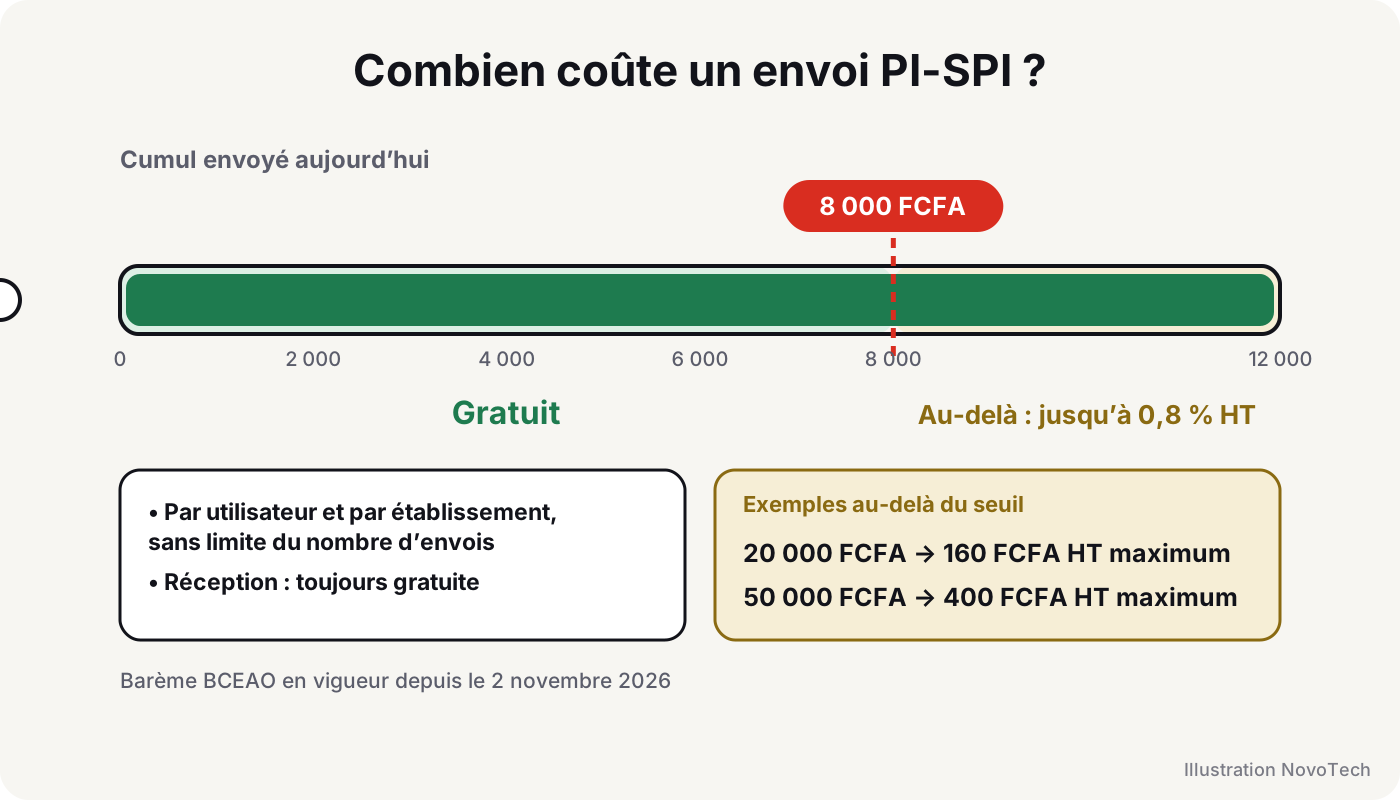
Maximum fee on a PI-SPI transfer in Senegal, by amount
In CFA francs before tax. Source: NovoTech calculation based on the BCEAO statement of October 2, 2026 (maximum rate of 0.8%, first transfer of the day)
“Per participant” means, on a literal reading, that a separate counter runs at each institution: 8,000 CFA francs sent from Wave and 8,000 from Orange Money on the same day both stay free. The statement does not say how a small transfer that pushes you over the threshold is treated, such as a second 5,000-franc transfer in a day, since it only targets transfers “of an amount above 8,000 CFA francs”. And 0.8% is a cap: an institution may charge less, or nothing. Go by the amount shown before you confirm.
A transfer from Wave to Wave, or from Orange Money to Orange Money, does not go through PI-SPI: the operator’s own price list applies, and Wave advertises 1%. Above 8,000 CFA francs, sending to another network can therefore cost less than an in-network transfer: at most 400 CFA francs before tax for 50,000, against 500 at 1%.
Not everyone has caught up. On November 14, the “Fees” section of the BCEAO’s PI-SPI website still showed the old schedule, with 30 free incoming transfers a month and fees capped at 1% beyond that. The more recent October 2 statement is the one that applies. The ceiling on wallet balances, for its part, has risen to 4 million CFA francs (see our October 21 guide).
What should I do if the money doesn’t arrive or goes to the wrong number?
One rule before you press “confirm”: a confirmed PI-SPI transfer is irrevocable, and your institution can no longer cancel it. That is why the app displays the first name, last name and country of the alias holder. If the name does not match, stop.
If the mistake is made, you can send the recipient a cancellation request from the app, free of charge. Anyone who receives money by mistake should, according to the BCEAO, select the transaction and choose the “return” (retourner) option, which refunds the sender at no cost. The platform cannot claw the money back on its own: if the recipient does not respond, you have to file a complaint.
If the money has left your account without arriving, note the date, time, amount and reference, take a screenshot and contact the institution it was sent from. Wave can be reached free of charge on 200 600 and Orange Money on 1441; for a bank, call its customer service or visit your branch. For an incident on PI-SPI itself, the path to redress is still unclear, RTS noted.
If the complaint goes nowhere, the Observatory of the Quality of Financial Services (OQSF) offers free, out-of-court mediation, including with e-money institutions.
How do I avoid instant-transfer scams?
Money that arrives in ten seconds leaves just as fast, and does not come back. On October 9, Senegal’s national police warned of a campaign targeting mobile money accounts: fake apps and booby-trapped links, shared on messaging apps and social networks under the guise of live matches, free films or easy money, are used to steal PINs and empty accounts remotely.
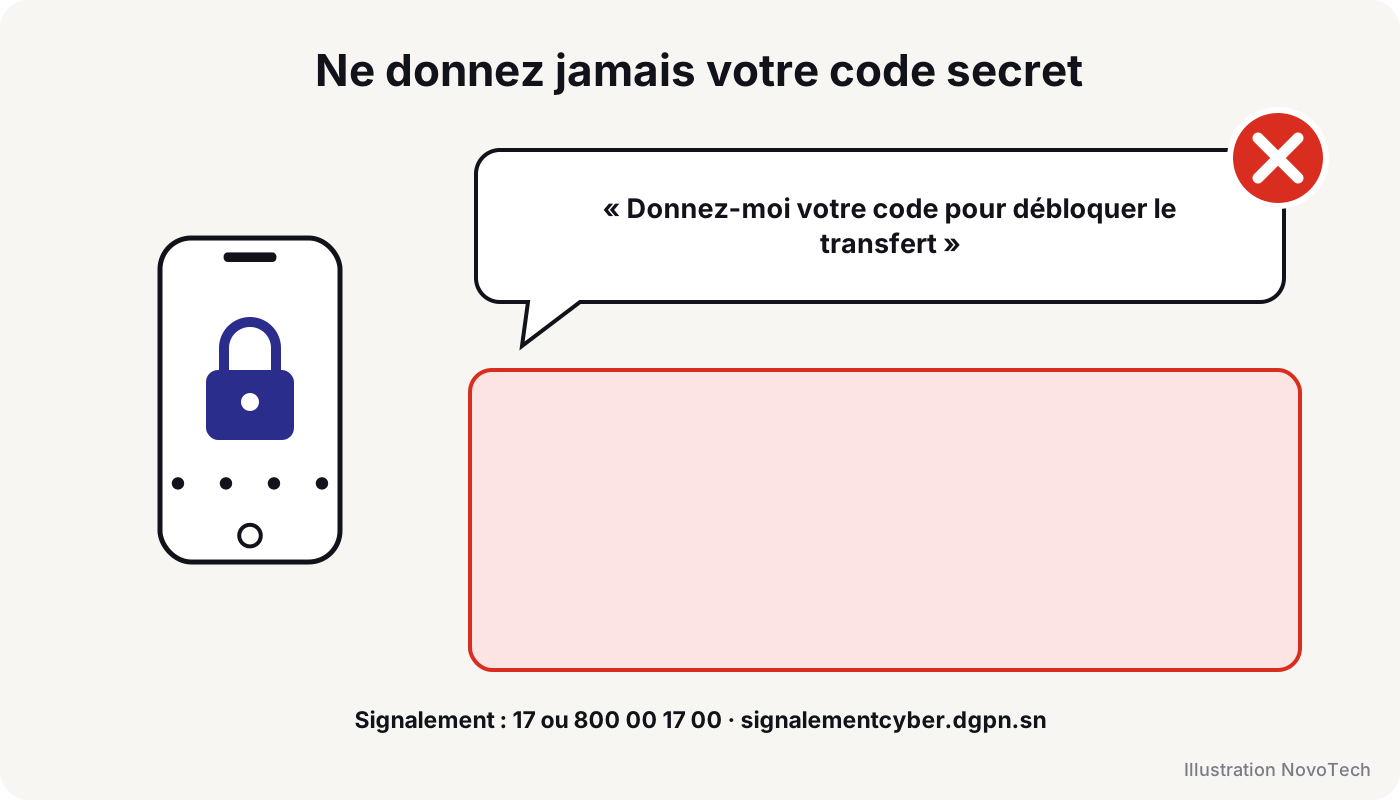
Your PIN is for no one else, not even someone claiming to be an agent of your operator, the police insist. Be wary of anyone offering to “activate” your free transfers: they follow from the BCEAO’s fee rules, with no step to take and no code to hand over. Install apps only from your phone’s official app store.
PI-SPI has its own safeguards. A payment request can only be accepted if it comes from one of your contacts or from a business: do not add a stranger to your contacts in order to approve one. To pay online, never scan a QR code displayed on a shopping website, the BCEAO warns; payment goes through a request received in your app, marked “verified e-commerce site” (Site e-commerce vérifié). And if someone says they sent you money by mistake, check your app’s history, not a text message: the “return” option sends funds back only to their real sender.
The timetable is not finished. Microfinance institutions have until June 30, 2027 to connect. And a transfer to Mali or Côte d’Ivoire, already possible, remains subject to your institution’s pricing until June 1, 2027, when transfers between the union’s eight countries move to the domestic fee schedule.
- Transactions de monnaie électronique entre personnes physiques par l’intermédiaire de la PI-SPI de l’UEMOA (communiqué du 2 octobre 2026), BCEAO.
- Foire aux questions (FAQ) de la PI-SPI, BCEAO.
- L’alias, BCEAO.
- Bank to Wallet et Wallet to Bank : la BCEAO chamboule les règles du jeu, Le Soleil (repris par OSIRIS).
- PI-SPI obligatoire : des transferts bancaires vers Wave et Orange Money échouent, Senego.
- Le Sénégal vit la révolution PI-SPI, SenePlus (d’après la RTS).
- Mobile money : le PI-SPI bouscule Wave, Orange Money et les petites fintech, Senego.
- Plateforme PI-SPI : le Sénégal en tête de l’UEMOA avec 43 participants sur 175, Dakaractu.
- Mobile money : l’alerte de la Police nationale pour vos comptes Wave et Orange, OSIRIS.
- PI-SPI, ce qui va changer pour votre portefeuille, Pulse Sénégal.
- Plateforme interopérable (PI-SPI dans Max it), Orange Côte d’Ivoire.
- Observatoire de la qualité des services financiers : saisir le médiateur, OQSF Sénégal.
- Wave - Mobile Money (fiche de l’application, numéros du service client), App Store.
- L’OQSF revendique près de 7 milliards FCFA de litiges réglés à l’amiable, SenePlus.
Spotted an error? Write to infos@novotech.blog. Corrections are flagged at the end of the article.